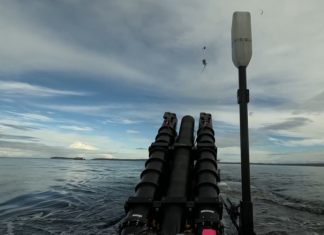
The U.S. Navy has successfully tested a robotic system that can capture, refuel, and release unmanned surface vessels (USVs) while both platforms are underway, USNI News reports. The August 11 demonstration off Virginia used a MARTAC Devil Ray T38, a nearly 40-foot autonomous vessel capable of speeds above 50 knots and carrying up to 4,000 pounds of payload, along with a towed robotic refueling device developed by Sealartec. The system completed dozens of capture-and-refuel cycles.
Blending the speed of a racing boat, the payload of a small cutter, and the endurance of a long-range patrol asset, the T38 makes no compromises in capability. According to Martac Systems, its advanced, stable-hull design provides the speed and stability needed for demanding autonomous missions. Designed for ISR, mine warfare, electronic warfare, anti-submarine reconnaissance, logistics, and surface strike, it can also serve as an autonomous mothership for launching and recovering smaller drones and underwater vehicles.

MARTAC says the T38 demonstrated its endurance with a 192-hour fully autonomous mission off California in May 2026, operating without chase boats or escorts. The mission demonstrated over-the-horizon operations, beyond-line-of-sight communications, autonomous navigation, payload integration, and Navy-validated range and endurance.
During the Navy’s refueling tests, the T38 received 400 gallons of fuel, while the robotic system completed roughly 100 connection cycles. The goal is to eventually automate the entire process—from rendezvous and capture to refueling and returning to the mission—allowing USVs to remain deployed longer without returning to port or relying on crewed support ships.
The capability could be a major step toward persistent autonomous naval operations, extending the endurance of drone vessels conducting surveillance, mine warfare, weapons testing, and other missions in high-threat environments while keeping sailors farther from danger.