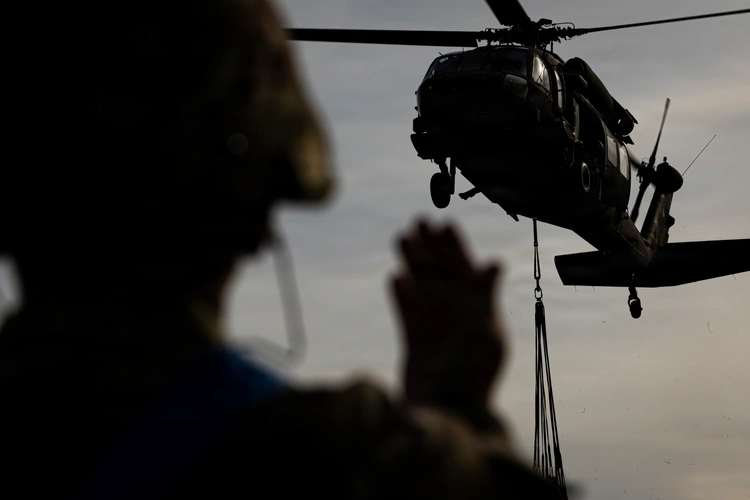
DARPA has transitioned its autonomous flight technology to the US Army, delivering an experimental UH-60 Black Hawk equipped with the MATRIX™ autonomy suite for advanced testing. Developed under the ALIAS program, the system enables highly automated flight to improve mission flexibility and safety in complex environments.
The technology has already demonstrated full mission capability, including uncrewed Black Hawk flights from takeoff to landing. The Army will now use the aircraft to further develop autonomous operations, integrate advanced sensors, and explore reduced-crew and fully autonomous aviation concepts. Darpa writes:
DARPA’s vision to reimagine the role of human pilots and revolutionize military aviation has culminated in the transition of a DARPA-developed autonomous flight system to the U.S. Army. As part of the technology transition agreement between DARPA and the Army’s Project Manager for Utility Helicopters, an experimental, fly-by-wire H-60Mx Black Hawk, fully equipped with the DARPA-funded Sikorsky MATRIX™ autonomy suite, has been delivered to the U.S. Army for advanced operational testing.
This milestone is the capstone achievement of DARPA’s Aircrew Labor In-Cockpit Automation System (ALIAS) program. The program’s objective was to create a highly automated system that could be integrated into existing aircraft to enhance mission flexibility and safety, particularly in complex and contested environments. The successful maturation and transfer of this technology to a service partner is a prime example of DARPA’s core mission: developing breakthrough technologies and reducing their risks for military adoption.
“The ALIAS program has successfully developed and demonstrated a powerful, flexible automation architecture that is now poised to provide the U.S. Army with a significant operational edge,” said Stuart Young, the ALIAS program manager in DARPA’s Tactical Technology Office. “This transition is a testament to the power of government and industry partnership to advance technology. It will allow the Army to build on a solid foundation of technical-risk reduction, enabling them to explore new warfighting concepts and push the boundaries of what’s possible in aviation.”
Under DARPA’s leadership, the ALIAS program rigorously developed, tested and proved the MATRIX technology, demonstrating everything from basic air maneuvers to complex mission profiles. A key achievement was the world’s first-ever uninhabited flight of a Black Hawk helicopter in 2022, proving the system could handle an entire mission from pre-flight checks to autonomous landing, including responding to simulated system failures.
With the foundational research and development complete, the Army Combat Capabilities Development Command (DEVCOM) will now own and use the experimental helicopter as a flying laboratory to mature and expand the technology. This next phase will focus on integrating advanced mission-specific sensors and exploring the unprecedented operational flexibility afforded by reduced-crew and fully autonomous flight.
Read more here.