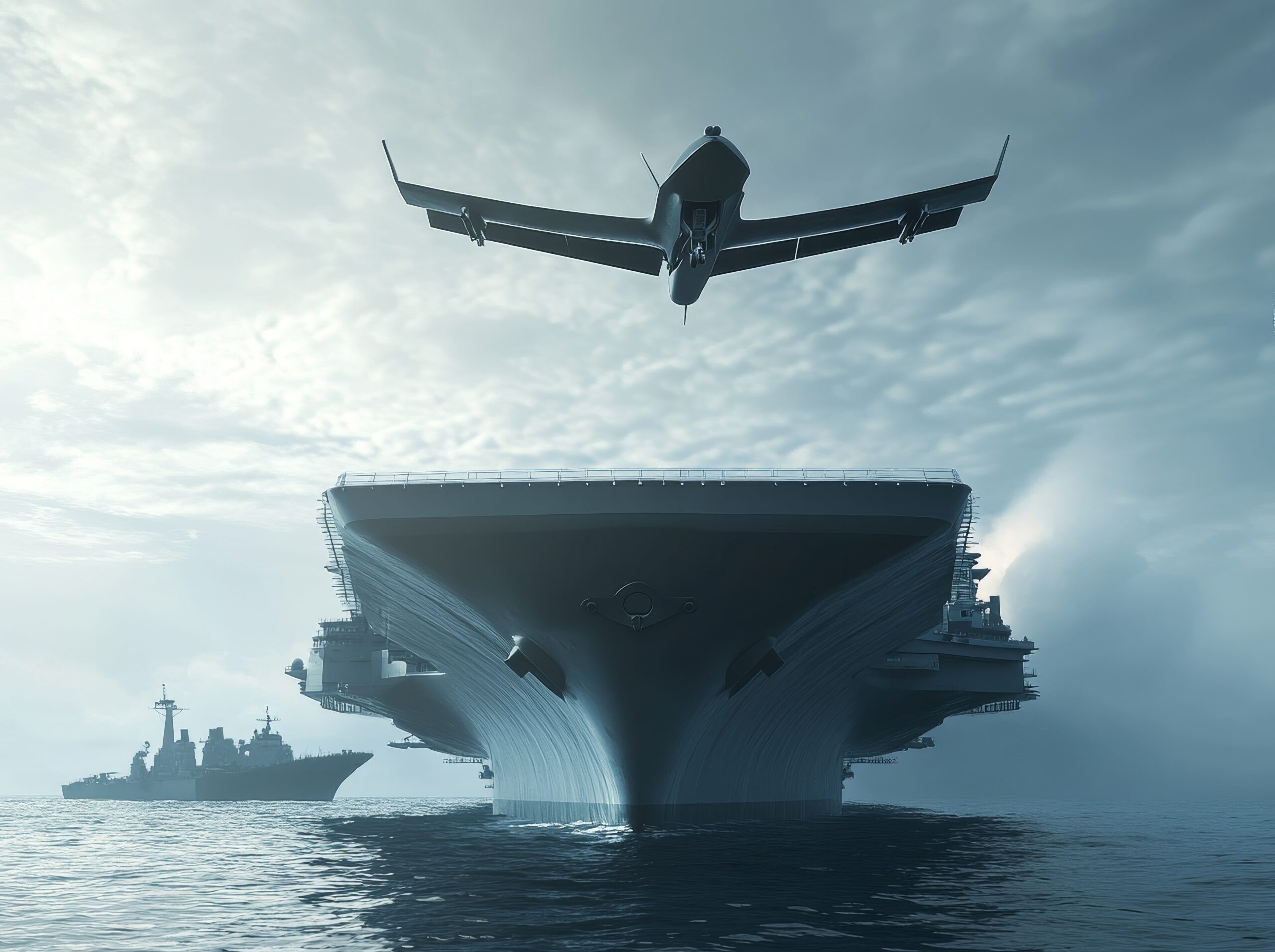
The US Navy has issued a Sources Sought notice and Request for Information (RFI) seeking industry concepts for next-generation unmanned carrier-based aircraft to support its future hybrid manned-unmanned carrier air wing under the Air Wing of the Future and Golden Fleet initiatives. The effort builds on existing MQ-25A Stingray and Collaborative Combat Aircraft (CCA) programs, expanding beyond refueling and loyal wingman roles to develop autonomous, scalable, and affordable aircraft capable of operating from Ford- and Nimitz-class carriers while integrating with existing command-and-control systems.
A key requirement is a combat radius of at least 1,000 nautical miles without refueling, allowing carriers to strike from greater distances, improve survivability against long-range threats, and expand operational reach. The aircraft are expected to perform missions including strike, ISR, electronic warfare, anti-submarine warfare, air defense, aerial refueling, and logistics. The effort aligns with broader Pentagon initiatives, including the Air Force’s Long Range Weapon program, which focuses on 1,000-nautical-mile strike capabilities against air, land, and sea targets.
On July 15, 2026, the Air Force’s CCA program recently reached a major milestone when Anduril’s YFQ-44A autonomous wingman drone successfully conducted its first-ever live missile firing from a US Air Force CCA, launching an AIM-120 AMRAAM air-to-air missile during testing. Together, these programs reflect the US military’s push for larger numbers of unmanned systems to increase combat mass, range, and survivability in contested environments, particularly in the Indo-Pacific.
The Navy’s RFI seeks industry input on development timelines, manufacturing scale, affordability, open architecture, sustainment, and investment plans to guide future unmanned aviation acquisition decisions.