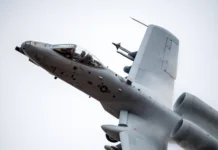
US Representative Abe Hamadeh introduced the bipartisan BRRRRT Act (Battlefield Readiness and Retention of Reliable Response Technology Act) to preserve the A-10 Thunderbolt II close air support mission and keep the aircraft in service until a certified replacement capability is operational. The legislation would require the US Air Force to maintain the A-10 fleet through Fiscal Year 2033, extending support for the battle-proven aircraft.
Iran’s asymmetric naval strategy in the Strait of Hormuz relies on small, fast attack boats, missile-equipped vessels, and swarm tactics designed to challenge larger naval forces. The A-10’s 55-year-old cannon, combined with APKWS laser-guided rockets, demonstrated a low-cost way to counter swarms of inexpensive attack boats, avoiding the use of million-dollar missiles against much cheaper targets.
Iran’s Islamic Revolutionary Guard Corps Navy (IRGCN) has built its maritime doctrine around low-cost, highly mobile platforms designed to overwhelm advanced warships through speed, numbers, and surprise attacks in the narrow waterway. Countering this threat requires a combination of naval power, air support, helicopters, drones, and affordable weapons better suited for sustained operations in contested coastal environments.
Supporters of the bill argue that the A-10 remains a critical close air support platform for protecting ground forces and should not be retired before an effective replacement is available. The measure seeks to address concerns over combat readiness, training, and maintaining a reliable capability for future battlefield operations.