You often hear when new taxes are proposed that they’ll only impact the rich and the wealthy. The income tax is the most famous example. Originally, it targeted only a few extremely wealthy Americans, but now that “temporary” tax is something nearly everyone who works must at least consider each year. As the Landmark Legal Foundation explains, that was only about 3% of the population:
The first federal income tax under the new amendment appeared in the Revenue Act of 1913. Unrecognizably low by today’s standards, the rates started at just 1% for those earning between $3,000-$20,000, or about $95,000-$640,000 in 2024 dollars. Over $20,000 of income, there were additional increments where a larger tax rate would be incurred, with a maximum combined rate of 7%. This rate only applied to income over $500,000, or $16 million in 2024 dollars.
We are obviously well beyond a 1% tax rate imposed on high earners in our current system. The modern American taxpayer had an average federal tax rate of nearly 15% in 2021. Furthermore, the Revenue Act stipulated that those who earned under the $3,000 threshold paid nothing at all, exempting the vast majority of Americans. In his book, The Great Tax Wars, political and economic correspondent Steven R. Weisman noted that “the tax would affect only the wealthiest 3% of the population,” or approximately 425,000 individuals.
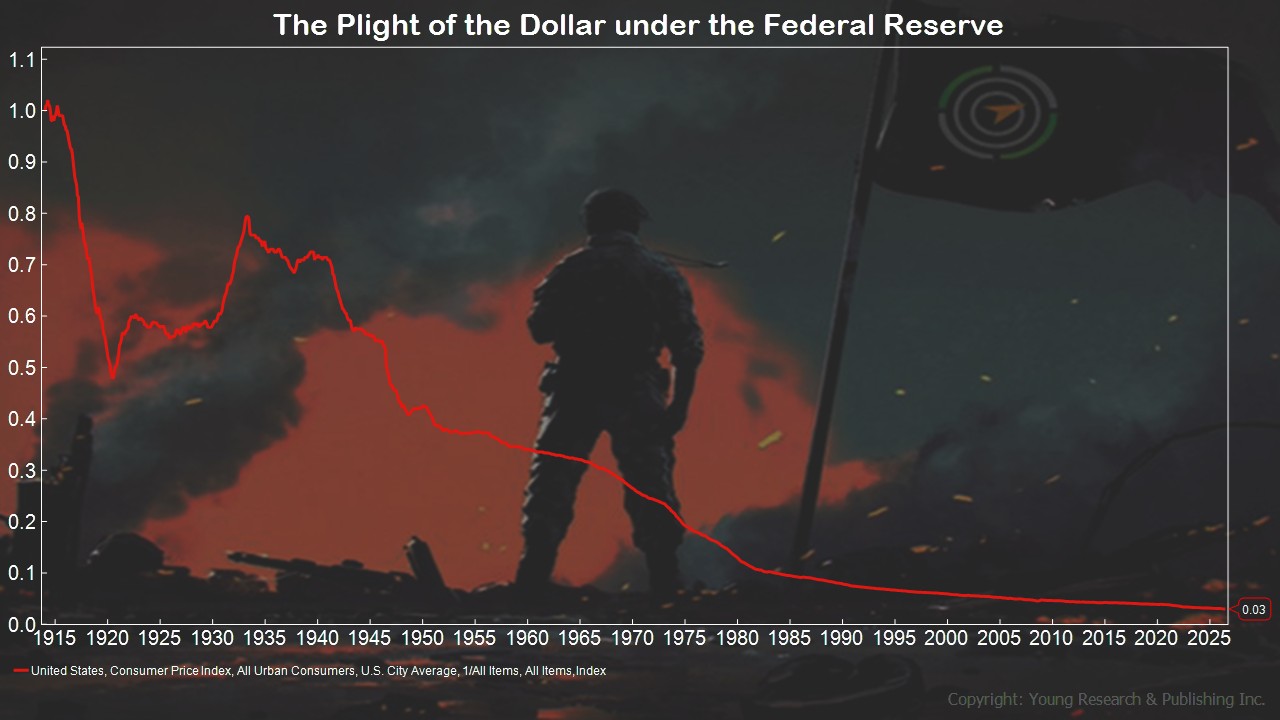
Part of the issue is that taxes aren’t usually indexed for inflation, so inevitably, as the dollar’s value is inflated away, more people become subject to the tax in nominal terms. Since the advent of the income tax in 1913, the same year as the founding of the Federal Reserve, the dollar has lost 97% of its value as measured by CPI.
 So when a politician is telling you they’ll “tax the rich,” one appropriate response could be, “When?” The answer likely to be that they’ll tax the rich today, and the middle class and even the poor tomorrow. Taxes always find bottom.
But inflation isn’t the only way taxes move down the income scale. Pretty soon after a new tax has been implemented, those affected find ways to minimize or avoid it altogether, and politicians lower the bar on who should be taxed. Richard Epstein explains at the Civitas Institute that for the recent pied-a-terre tax imposed by New York City, the definition of “rich” is already being defined downward. Epstein writes:
A week ago, the Times and others wrote as if this tax were targeted on the rich by concentrating exclusively on single-family homes. But the real shocker is how regressive this new tax is relative to its stated purpose. As a first approximation, if the out-of-state rich persons—or in-staters with two or more homes—are scourges, it should not matter whether their second home is a house on the one hand, or a co-op or condo on the other. But the city’s tables differentiating between houses and condos read very differently. For co-ops and condos, the burden starts at $1 million, a number that does not place its owner in luxury, but buys a small studio or a one-bedroom condo. However, that tax rate for co-ops and condos is five times the 0.8 rate that homeowners pay on houses worth $5 million. That ratio is not a bug but a feature of the system, because Ken Griffin’s $239 million house (may he enjoy it in peace) is taxed at a rate only 20 percent of the tax on a $5 million apartment.
The tax figures on the houses may be sustainable for billionaires, but few owners of so-called non-primary homes could or would pay $40,000 to $120,000 per year in addition to their regular taxes and fees for the privilege of getting a foot into the second-home market. Include the condos and co-ops in the base, and it was never fair to that the “pied-à-terre tax is both modest in size and narrowly targeted.” Instead, individuals who live in condos and co-ops are far more likely to sell to buyers who are permanent residents in the city. However, even here there are complications for many of these families who may split their time between New York City and some other location, at which point they will have to fight their way out of the web by proving that their city residence is their primary one. And lest anyone think they can sit tight before making a move, the applicable regulations state that these homeowners have to apply for the needed exemption, which means the statute will embroil everyone on that huge list of names to some extent. This will increase, probably exponentially, the number of disputes between owners and the city authorities as to the status of the property, meaning the administrative costs to both the city and to all the homeowners will eat up a fair portion of the putative gains so that it is quite likely that, in the long run, the measure will raise little, if any, revenue at all once the tumult settles down if it ever does. And if the retroactive application holds, the minimum tax already incurred is for the cheapest units over $20,000 and rising daily. The possibilities for constitutional challenges are sure to be raised, and soon.
Mayor Zohran Mamdani wants to take wealth from New Yorkers and spend it on his own radical socialist political agenda. He plans on funding grocery stores with taxpayer dollars. He’s stripping landlords of their rights. And he’s putting businesses at risk. Mamdani is the pickpocket of New York.
Action Line: If you live in a place like New York City, and your politicians’ only concern for you is how they can take your money to fund their radical agenda, you may want to look for a better America. Begin your search with Your Survival Guy’s 2026 Super States rankings, and click here to subscribe to my free monthly Survive & Thrive letter.
Originally posted on Your Survival Guy.