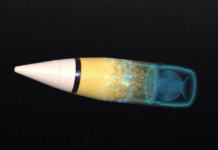
Joseph Trevithick andHoward Altman of The War Zone reports that the US Air Force units in the Middle East have made laser‑guided 70mm APKWS II rockets, and their air‑to‑air optimized AGR‑20F variant with a proximity fuze, their primary weapon against hostile drones, has been fielded on F‑16s and now extended to F‑15Es and A‑10s; AFCENT reports “scores” of shoot‑downs. Originally an air‑to‑surface munition, APKWS II offers much lower unit costs and far greater magazine depth than traditional air‑to‑air missiles, allowing aircraft to carry dozens of rockets in pods to counter swarms and sustain prolonged engagements. The weapon’s combat success (also demonstrated in Ukraine), ongoing integration across platforms, and work on a dual‑mode seeker underscore its growing role as a cost‑effective, proven solution for countering unmanned threats. They write:
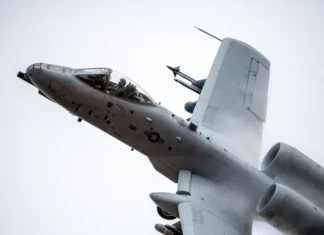
Laser-guided 70mm Advanced Precision Kill Weapon System II (APKWS II) rockets have become the U.S. Air Force’s principal air-to-air weapon against drone threats in the Middle East. Air Force F-16 Vipers in the region first began using the rockets operationally in the anti-role last year, which TWZ was first to report, and that capability has now been extended to the F-15E Strike Eagle and A-10 Warthog.
“It’s our primary weapon against a drone,” Air Force Lt. Gen. Derek France, head of Air Forces Central (AFCENT), the service’s top command in the Middle East, told TWZ‘s Howard Altman on the sidelines of the Air & Space Forces Association’s 2025 Air, Space, and Cyber Conference yesterday. “We’ve had multiple shoot-downs with it.”
When asked for further details, an AFCENT spokesperson could not provide a hard figure for the total number of drones downed to date in the region using APKWS II rockets, but described it as “scores” of them. […]
The APKWS II guidance section has a unit cost between $15,000 and $20,000, with the rocket motor and warhead adding a few thousand dollars more to the full price tag. Current generation AIM-120s cost around $1 million apiece, while AIM-9X has a price point around $450,000. On top of that, Air Force aircraft fire APKWS IIs from seven-shot pods, and certain individual pylons on the F-16C, F-15E, and A-10 can accommodate multiple pods at once. The Strike Eagle can notably carry up to 42 rockets in six pods on just two stations, and can still carry eight more air-to-air missiles, as can be seen below. […]
APKWS II’s position now as the Air Force’s go-to air-to-air munition against drones in the Middle East can only put new emphasis on its value in this role.
Read more here.
On October 10, Ukrainian air defense units successfully intercepted a Russian Kh-69 cruise missile (costing around $500,000 per unit), using a low-cost APKWS laser-guided rocket ($25,000), according to Ivan Khomenko of United24 Media. The engagement, confirmed by Ukraine’s Air Force Command and OSINT analysts, marks a significant milestone as the APKWS, originally designed for drone defense, proved effective against a high-end cruise missile. The Kh-69, one of Russia’s most advanced air-launched weapons, was deployed during a massive aerial assault involving over 460 threats. Ukraine’s defenses downed the majority of these, showcasing both adaptability and resilience.