The report “White Paper on Russian Acts of Sabotage and Subversion against Members of the Council of the Baltic Sea States,” published by the Polish Institute of International Affairs, argues that Russia is conducting an escalating hybrid campaign against countries in the Baltic Sea region following the start of the war in Ukraine.
It documents a wide range of activities, including sabotage of critical infrastructure, arson, cyber and influence operations, border violations, and repeated disruptions of satellite-based navigation (GNSS) affecting maritime and air traffic. It also highlights the suspected use of proxy actors and intelligence-linked networks across several European states.
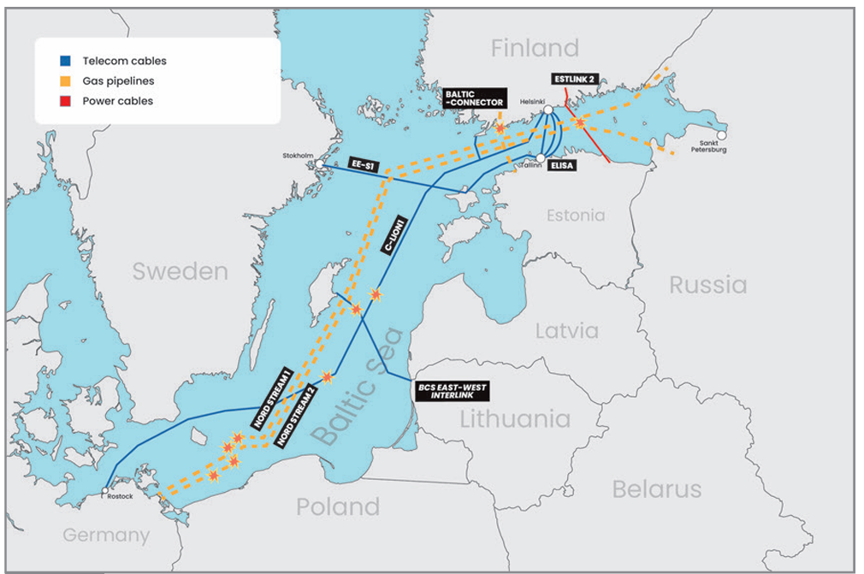
They emphasize that these activities target energy, transport, and communications infrastructure—particularly undersea cables and pipelines in the Baltic Sea—and are intended both to cause physical disruption and to exert psychological pressure on European societies. It frames these actions as part of a broader pattern of coordinated “gray zone” operations.
It concludes that European Union and NATO members should strengthen coordination, enhance monitoring of maritime and critical infrastructure, and develop stronger legal and operational responses to deter further hybrid threats.