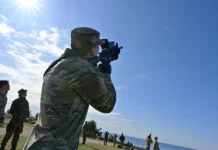
Raytheon showcased a virtual-reality demo of its Next Generation Short Range Interceptor (NGSRI), a proposed Stinger replacement that pairs enhanced optics with a faster, longer-range munition. In the demo, a soldier used the new sight to detect and swiftly destroy an incoming drone, illustrating how the system could reduce warfighter risk. Raytheon says it built a prototype, completed multiple subsystem demonstrations, and plans the first full missile flight by the end of 2025. RTX writes:
On his shoulder is a missile launcher. Before his eyes is an advanced new optic with enhanced zoom and the ability to see in a way he never thought possible. And in the launcher is a munition that can fly farther and faster than its predecessor.
His eyes could only see a row of trees against a mountain range in the distance. But the optic sees an incoming drone. In seconds, he targets and destroys the threat.
The scenario unfolded during a virtual reality demonstration of Raytheon’s proposed replacement for the Stinger missile. And it showed a glimpse into the future of defense.
Raytheon, an RTX business, built the demonstrator with two objectives: to show the U.S. Army the potential of the business’ Next Generation Short Range Interceptor – and to invite operators to try it for themselves and help refine the design.
“That night scenario was a big aha moment for some of the warfighters who got on this,” said Lindsey Hoffman, Raytheon’s Next Generation Short Range Interceptor capture director. “There was a quote from a Marine, who looked at us and said, ‘This takes the fear away.’ That quote stuck with all of us.”
What can the Next Generation Short Range Interceptor do?
The current Stinger missile, made by Raytheon, can be fired off the shoulder, from the U.S. Army’s SGT STOUT armored vehicle, or an air-based platform like an Apache helicopter. More than 25 countries have depended on the system for over 40 years. Hundreds of the launchers are in use today.But the battlefield is changing. Weapons have longer ranges. There are more drones, and they’re hard to target. Air spaces are harder to access. So, it became clear that the Stinger missile, effective as it had been, needed an upgrade.
“The legacy Stinger is still the best portable air defense system in the world,” said Brenda Ortiz, Raytheon’s vice president for short-and medium-range ground-based air defense, “but what we can do with NGSRI is really going to take it to the next level.”
In less than two years, Raytheon designed a prototype, incorporated soldier feedback and successfully completed 10 subsystem demonstrations. By the end of 2025, its creators plan to fly the full missile system for the first time.
Here are a few of the system’s highlights
Flies faster, farther – A highly loaded grain solid rocket motor packs more power into the same footprint
Advanced seeker – The new seeker, when paired with a new shoulder-mounted command launch assembly, can see farther and more clearly – in both night and day scenarios
Backward compatibility – The system is fully compatible with launchers already in the field so it can be used in battle as soon as it’s delivered
Faster production – A composable design and advanced manufacturing means faster development and production to counter increasing numbers of drones
Developing first-of-its-kind technology
Usually, you can make a missile fly far, but it won’t be as fast. Or you can make it faster, only it won’t fly as far. So, how do you make a missile that can do both?
According to Raytheon’s Next Generation Short Range Interceptor Technology Director, Will Strauss, you build something completely new.
Raytheon worked with Northrop Grumman to design a highly loaded grain solid rocket motor, which benefits from packing fuel more densely to improve performance without increasing the motor’s size. In less than six months, they advanced from a proof of concept to a first flight in the missile’s new form.
“The rocket motor itself is a really, really fixed volume, so it is a challenge to get more range out of it,” Strauss said, “but we are getting a significant amount.”
Soldiers will not only be able to fly missiles farther and faster, they’ll also be able to detect threats sooner with an advanced seeker that provides more detail – even for small targets like drones, which give off less heat and are harder to spot.
Read more here.
How the Stinger Missile Turned the Tide in Afghanistan
By the mid-1980s, the Soviet-Afghan war had reached a stalemate, prompting the US to supply Afghan rebels with the portable, heat-seeking Stinger missile to counter Soviet air attacks. Despite initial resistance and concerns over escalation, the Stinger proved highly effective, forcing the Soviets to alter tactics and significantly weakening their air power. This shift contributed to the Soviet decision to withdraw in 1989, marking the Stinger program as a pivotal factor in the conflict and a major success for US covert operations.
Stinger Missile Production Boosted to Support Ukraine and International Buyers
The US Army awarded Raytheon a $578.6 million contract to supply Stinger anti-aircraft missiles and related support through 2031, according to The Defense Post. Originally out of production for nearly 20 years, demand surged due to Ukraine’s defense needs, along with interest from Morocco, Egypt, Germany, and Taiwan. The Stinger, an infrared-guided missile effective up to 5 miles and 11,500 feet altitude, is also being refurbished under a service life extension program while a next-generation replacement is in development. Raytheon is collaborating with Germany’s Diehl Defence to produce key components in Europe. They write:
The US Army has awarded Raytheon a $578.6-million contract to procure Stinger anti-aircraft missiles, along with related equipment and support.
Deliveries are scheduled through September 29, 2031.
The contract follows a $624-million production award to Raytheon in 2022 to replenish the 1,300 Stingers supplied to Ukraine for its defense against Russia’s invasion. […]
In addition to the Ukraine war, potential foreign military sales of the missiles include orders from Morocco and Egypt, while the German Parliament has approved its purchase.
Taiwan has also announced plans to procure around 2,000 Stinger missiles from the US amid rising tensions with China.
Meanwhile, the Stinger is undergoing a service life extension program, with 1,900 missiles refurbished last year, even as its replacement, the Next-Generation Short-Range Interceptor, is under development.
Read more here.