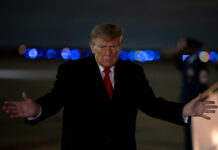
Which is Donald Trump? A naïve weakling, willing to roll over for foreign dictators, or is he a mad king, dragging the country into World War III?
Daniel Oliver gives readers the answer in American Greatness. Depending upon whom you listened to, you’d be forgiven for thinking that our President is too cowardly to stand up to our enemies and too dangerously aggressive to be trusted as commander-in-chief.
Coming forth first, we have Senator Dick Durbin (D-IL), the Senate Minority Whip, bursting with moral outrage only a year ago over Trump’s foreign policy toward Russia. Warned Durbin:
“President Trump has always had a strange affinity for autocrats and dictators—a troubling stain and liability for the leader of the free world. Simply caving to Putin and walking away from Ukraine—just as Chamberlain did to Hitler—is an invitation for more confrontations in the future.”
Next up is the highest-ranking member on the Foreign Relations Committee. Senator Jeanne Shaheen (D-NH) was equally horrified by Trump’s diplomatic impotence. Explained Shaheen:
“It’s clear that Vladimir Putin is manipulating Donald Trump, and it shows what a weak position he’s in that he doesn’t understand that he’s being manipulated. Vladimir Putin is a murderous dictator. He is a thug who understands one thing, and that is strength. . . . It’s unfortunate that we have a president who doesn’t understand that.”
When Trump announced the U.S. would be conducting Operation Epic Fury, the title reflected the long-overdue justice being brought to a regime that has spent nearly half a century exporting terror throughout the Middle East. The political DNA of Iran’s recently deceased Ali Khamenei was forged in the 1979 revolution and the siege of the U.S. embassy in Tehran—the beginning of a 444-day hostage crisis to free the Americans Iran had abducted.
Khamenei remained the supreme and embittered leader of the regime till his final days while still praising the crime as recently as November 2025, celebrating the embassy’s fall as a “day of pride and triumph.”
As missiles of Operation Epic Fury finally began to fall, President Trump was delivering the very “strength” of which Senator Shaheen claimed he was incapable.
With the Iranian regime crumbled, the halls of Congress were filled not with victory laps but with the noise of grinding gears frantically trying to shift the narrative, writes Daniel Oliver in American Greatness.
The same lawmakers who had spent years lamenting Trump’s “strange affinity for autocrats” were suddenly horrified to find him actually dismantling one.
Next came Senator Durbin, gravely intoning about the consequences of acting against Iran:
“A war in Iran with the goal of regime change could be another long-term military commitment with deadly consequences for thousands of American troops. The rash and unpredictable conduct of President Trump is a well-established worry in many ways, but an impulsive commander-in-chief is a deadly combination.”
Senator Shaheen offered a perfunctory nod to the Iranian regime’s blood-soaked history before she retreated to the safety of a “however.”
Impressively, notes Mr. Oliver, Shaheen manages to praise the result while pathologizing the president who achieved it. The “strength” she had insisted was necessary for dealing with dictators turned into a “lack of strategy” when it was deployed.
Top Democrats’ pivoting reveals a cynical truth about modern American legislature, continues Mr. Oliver.
For members like Durbin and Shaheen, the goal isn’t actually a consistent foreign policy; rather, it’s the maintenance of a carefully constructed fence of deniability. By labeling Trump a weakling one year and a mad king the next, they ensure that—no matter the outcome—they are never the ones left holding the bag.