Ukraine has intensified its drone attacks on Russian energy infrastructure, targeting major oil refineries on Thursday: Gazprom’s Neftekhim Salavat facility in Bashkortostan and Lukoil’s Volgograd refinery, according to Bloomberg. The Salavat strike, over 1,300 km from Ukrainian-controlled territory, marks one of Kyiv’s deepest attacks inside Russia. These strikes are part of a broader effort to disrupt Russian fuel supplies to the front lines, with at least 13 attacks reported in August and several more in September. The recent attacks have forced shutdowns, reduced Russian refining output to its lowest since April 2022, and cut crude exports significantly. While Ukraine’s Western allies have remained publicly silent, they haven’t criticized the strikes, signaling a shift from earlier positions. Meanwhile, the G7 is preparing a new sanctions package against Russia. They write:
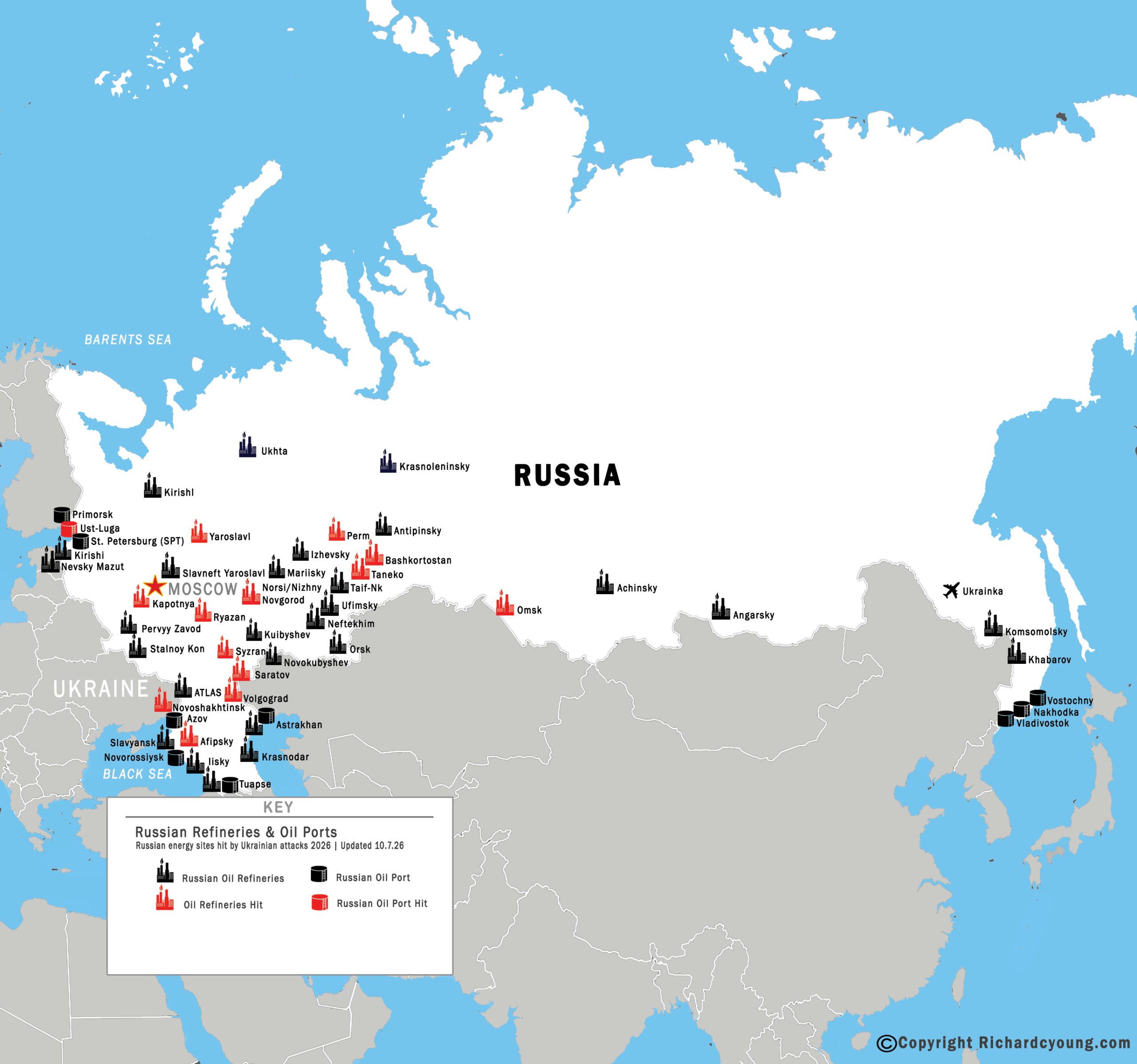
Ukraine attacks on Russian Oil Refineries & ports since the start of the war. (Click to enlarge)
Two Russian oil refineries were attacked on Thursday as Ukraine stepped up strikes on its enemy’s energy infrastructure.
Gazprom’s Neftekhim Salavat petrochemical facility in the Bashkortostan region was set on fire after being hit by drones, local governor Radiy Khabirov said. The site is more than 1,300 kilometers (800 miles) from territory under Ukraine’s control, making it one of Kyiv’s deepest strikes inside Russian territory.
Ukraine’s Special Operations Forces also claimed an attack on Lukoil PJSC’s major Volgograd refinery in the Volga region. […]
Since last month, Ukrainian military forces have intensified drone attacks on Russian energy infrastructure, including oil refineries, aiming to curb fuel supplies to the front lines. In August, at least 13 strikes were made, the largest monthly number since the start of the invasion in Ukraine. So far in September there have been at least six attacks. […]
So far, Ukraine’s allies have mostly ignored the attacks. While Washington and Brussels haven’t given public support for the strikes, they haven’t criticized either. That’s a shift from when Joe Biden was in the White House and members of his administration would reprimand Kyiv for incursions that affected Russia’s oil industry.
KONGSBERG has successfully tested a containerized launch system for its Naval Strike Missile (NSM), demonstrating a new deployment option using a standard 20-foot shipping...
The Royal Australian Navy is expanding the capabilities of its Ghost Shark autonomous underwater drones, developed by Anduril, equipping them with sea mines, logistics...
The Pentagon is assessing the damage to U.S. military bases across the Middle East and weighing the costs of rebuilding against potential changes to...
Russia’s military satellite Kosmos 2612 reportedly maneuvered to within approximately 85 feet (26 meters) of ICEYE X36, a U.S.-registered commercial radar-imaging satellite, on October...
Israel Aerospace Industries (IAI) and SIG SAUER have successfully completed a firing test of FIRE STORM 250, an innovative tactical unmanned aerial system (UAS)...
Sikorsky, a Lockheed Martin company, introduced the Nomad 100 fast pack, a containerized vertical takeoff and landing (VTOL) uncrewed aerial system (UAS) designed to...