A US Air Force F-15E Strike Eagle was shot down by MANPADS over Iran on April 3, marking the first crewed aircraft loss during Epic Fury. Both crew members ejected safely but landed in hostile territory. The Weapon Systems Officer (WSO) suffered injuries and evaded capture by climbing rugged mountain terrain and hiding in a crevice, while the pilot was recovered first.
The rescue involved a massive, complex operation with hundreds of troops, dozens of aircraft—including A-10s, HH-60W Jolly Green II helicopters, MC-130Js, and B-2 bombers—and diversion operations across multiple locations to mislead Iranian forces, according to The War Zone. The WSO was located using advanced technology, including the Combat Survivor Evader Locator (CSEL), CIA assets, and support from Israeli intelligence.
The CIA reportedly deployed a cutting-edge system called “Ghost Murmur,” which combines long-range quantum magnetometry with AI to detect and isolate the unique electromagnetic signature of a human heartbeat. This allowed operators to identify individuals even in complex, hostile environments, as reported by the New York Post.
The operation, conducted in broad daylight under heavy enemy presence, demonstrated high-risk coordination, advanced planning, and cooperation between US and allied forces. Both airmen were successfully recovered, highlighting the lengths the US will go to protect its personnel. TWZ writes:
Bleeding from injuries incurred ejecting from his F-15E Strike Eagle fighter and climbing a craggy mountain to escape, the U.S. Air Force Weapon Systems Officer (WSO) hid out in a crevice as both rescuers and Iranians frantically searched for him. Monday afternoon, President Donald Trump and Air Force Gen. Dan Caine, chairman of the Joint Chiefs of Staff, offered new details about the complex and dangerous missions to rescue the WSO and pilot – call signs DUDE44 Bravo and DUDE44 Alpha – whose Strike Eagle had been shot down April 3, the first loss of crewed aircraft to enemy fire during Epic Fury. […]
As the CSAR package, protected by a fighter strike package, crossed into Iran, “A-10s and …drones and other tactical aircraft were violently suppressing and engaging the enemy in a close in gunfight to keep them away from the front seater and allow the pickup force to get into the objective area,” Caine noted. During this engagement, one of the A-10s – “the one primarily responsible for communicating with the downed pilot, was hit by enemy fire,” said Caine. “This pilot continued to fight, continued the mission, and then upon exit, flew his aircraft into another country and determined that the airplane was not landable… The pilot then made the decision to eject over friendly territory, and was quickly and safely recovered and is doing fine.” […]
The WSO was located thanks in large measure to help from the CIA. […]
Details about the rescue op for the U.S. Weapon Systems Officer, via a U.S. military official:
“The mountain top area on the left is where the WSO was hiding (he ejected 5ish miles northwest of there). The right area is the makeshift landing strip where they landed 2 C-130s… pic.twitter.com/iYJkzd5eTP
— Michael Weiss (@michaeldweiss) April 5, 2026
This rescue operation was certainly a bright spot for a White House and Pentagon beleaguered by global criticism of an unpopular war that has dragged on for more than a month with no clear end in sight. It also highlights that, no matter how much damage the U.S. and Israel have done to the Islamic Republic’s air defense infrastructure through a devastating aerial campaign, Iran still presents a danger to the aircrews flying in its airspace. Above all else, it is a reminder of just how far the U.S. will go and what it is willing to sacrifice in terms of lives and material in order to get their people back.
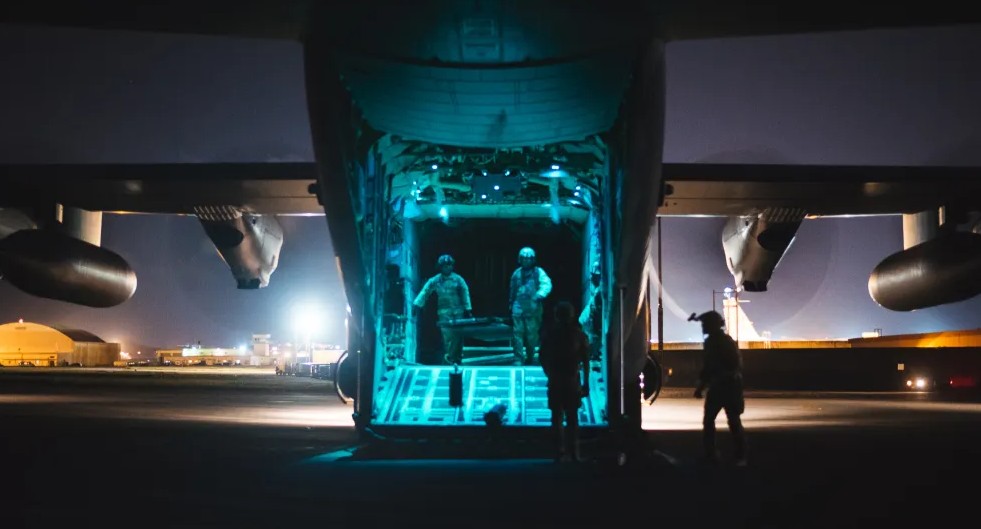
The mission also involved a major logistical effort, with MC-130J aircraft delivering equipment and MH-6 Little Bird helicopters, which can be carried inside the MC-130 and assembled in about 15 minutes, to fly directly to the mountaintop and insert the rescue team. Poor weather caused the MC-130s to become stuck on the ground, and both they and the Little Birds were ultimately destroyed by US forces to prevent sensitive technology from falling into enemy hands.
Updated April 9th 2026: Some reports indicate that three additional DHC-8 aircraft were then deployed to extract the special forces contingent and the rescued pilot, according to AeroTime. The DHC-8 (Dash 8) is specifically designed for rugged, short-takeoff and landing (STOL) operations, capable of using unpaved surfaces like gravel, ice, or packed dirt, making it ideal for remote and challenging environments.