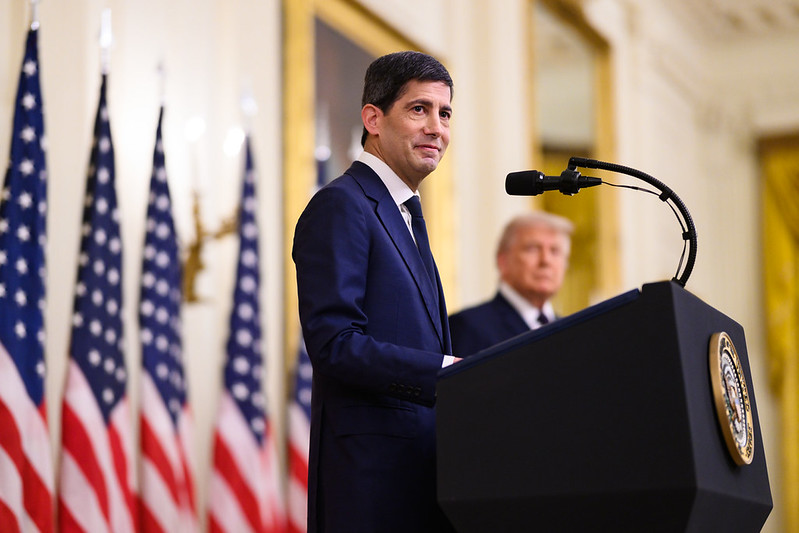
At the Cato Institute, Jai Kedia and Norbert J. Michel encourage newly appointed Federal Reserve Chairman Kevin Warsh to follow through on his intention to decrease the Fed’s balance sheet, and they respond to a number of the common arguments against shrinking the balance sheet with logical rebuttals. For example:
- Reserves are costless to create, so a large balance sheet with abundant reserves is the efficient policy choice.Fed officials have argued that since reserves can be created at a zero marginal cost, economic efficiency requires that their opportunity cost to banks also be zero. While the accounting cost of creating these reserves may be zero, their economic costs are high. For starters, every dollar in created reserves must be backed by asset holdings. If the rate of return on those assets does not match the cost of paying banks interest on reserves (IOR), the Fed can suffer losses. The Fed accrued nearly $200 billion in operating losses in 2023 and 2024 in this manner—losses ultimately borne by taxpayers through forgone Treasury remittances.
Among other potential costs, the abundant reserve framework enables fiscal quantitative easing (QE), allowing Congress to fund spending programs through the Fed’s balance sheet without going through the appropriations process. (For a more detailed analysis of the costs associated with the current regime, see this post.) A balance sheet of this size also distorts financial markets. The Fed’s decision to purchase nearly $3 trillion in mortgage-backed securities preferentially allocated credit to the housing market and amounted to a backdoor bailout of Fannie Mae and Freddie Mac, one that relieved Congress of its responsibility.
They conclude:
Kevin Warsh’s chairmanship offers a rare chance to seriously reform the Fed. Key among these reforms is shrinking the balance sheet. Most arguments supporting the permanently large balance sheet seem to exhibit a fundamental misunderstanding of the appropriate role of the central bank—some Fed officials seem to think that it should provide general bank lending instead of emergency lending. But the Fed is supposed to be a lender of last resort to markets, not a buyer and lender of any resort, actively participating in what amounts to government-supported credit allocation.
Regardless of policy preferences, both critics and supporters of the Fed must admit that the central bank now has many responsibilities that Congress never intended. The Fed is now tasked with achieving specific macroeconomic goals, providing fiscal support to the federal government, regulating thousands of banks and other financial institutions, engaging in credit allocation to private institutions, and operating core components of the payment and settlement system. Ideally, Congress will start to reverse this trend and shrink the Fed’s responsibilities so the central bank’s footprint will be more compatible with a limited government and a free-enterprise economy.
The Fed serves the US public best when it does less, not more, and an overly active central bank undermines free enterprise and increases risk within the financial sector. The new Fed chair has an excellent opportunity to improve economic outcomes by putting the Fed on this path.
Read more here.