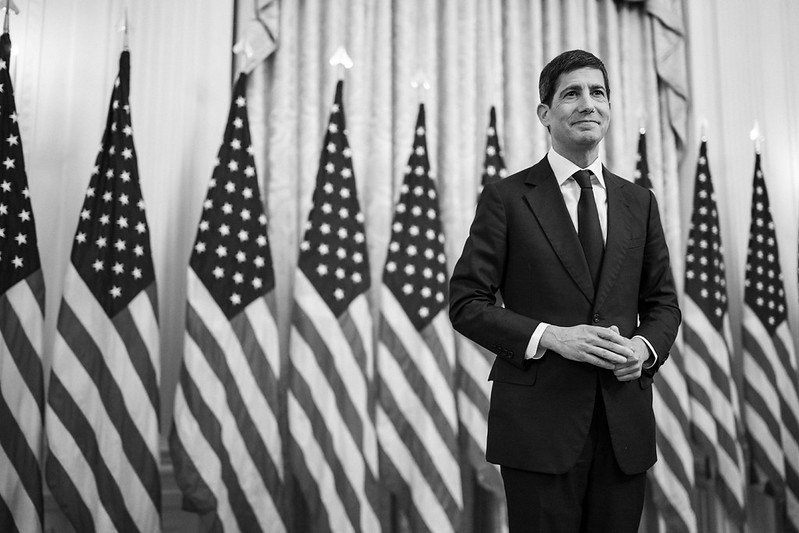
UPDATE 7.14.26: Today, the CPI numbers were released for June, and they were lower than expected, with prices actually down 0.4% from May, and up 3.5% from last year, after analysts had predicted a rise of 3.8%. Recently, Federal Reserve Chairman Kevin Warsh told a meeting of lawmakers that “The members of our committee have no tolerance for persistently elevated inflation, and we share a resolute commitment to restoring price stability.” Recently, Warsh told the House Financial Services Committee, “If we get policy right—and we will—the inflation surge of the last five years will be a thing of the past.”

Originally posted June 24, 2026.
You may have seen Federal Reserve Chairman Kevin Warsh’s press conference on June 17, but if you didn’t, there are some things you should know.
One of the most welcome statements from Warsh was his answer to a question about the Fed’s “ongoing guidance” asked by Ed Lawrence of Fox Business. Since the Bernanke era of the Fed, there’s been a lot of focus on communication from the central bank about what it would do next. Speeches by Governors and Presidents would pre-signal the Fed’s intended actions, and markets would adjust ahead of the meeting to the expected outcome.
That was in stark contrast to what existed before Bernanke’s Fed. Before Bernanke, there was the recently deceased Alan Greenspan (RIP). Greenspan was a master of “Fedspeak,” or the ability to ambiguously discuss the economy and the Federal Reserve’s view of the economy without giving away any hints as to what the Fed might do next.
It appears that Chairman Warsh may return to employing Fedspeak, rather than pre-signaling every move the Fed will make. He responded to Lawrence’s question on guidance as follows (YSG’s emphasis added in bold):
So I think financial markets perform best when they react to incoming data. I think the financial markets work less efficiently when they ask a question. How will the Federal Reserve react to that incoming information? The more that markets are paying attention to what’s happening in the real economy, deciding what’s good data and what’s less good data, the more financial markets can price what they believe is the most likely and what are the tail risks. Financial market prices are probably the most important source of information to guide central bankers. But when all the financial markets are doing is reflecting back what we’ve said, then we’re taking the most important source of information and we’re being blind to it. I’d like us to create a system where those blinders come off, where markets are following data that they efficiently think is reliable. And they’ll be watching data, we’ll be watching data. They’ll come with better information through market prices to us, we can make more informed decisions. But ultimately, the goal that I said at the outset, deliver on the price stability objective that Congress told us to do, and that we’ve got to get in the business of doing.
Monetary policy can’t be a reaction to a reaction, caught in a cycle. It has to reflect the reality of the economy, and Wash is putting markets to work, figuring out the real economy, rather than making bets on future Fed policy.
One area where Warsh’s messaging was unambiguous was his critique of the Fed’s recent failures on inflation. In response to a question from Chris Rugaber from the Associated Press on inflation, Warsh explained (again, my emphasis in bold):
So I can’t do much better than the committee just did, so let me restate it. Inflation remains elevated relative to the committee’s 2 percent goal, in part reflecting supply shocks that have driven price increases in certain sectors, including energy. That paragraph goes on to say, “But to be clear, the Fed will deliver price stability.” My own judgment is the committee spent quite a bit of time not just in two days but over iterations of a couple weeks. That’s what we’re prepared to say about inflation, but the commitment to deliver is strong, unanimous, and unambiguous. And that’s I think an important message we’ve missed for five years, and we’re going to fix that.
Action Line: Warsh’s comments were an indictment of former Federal Reserve Chairman Jerome Powell’s failure to tame inflation faster, both during the Biden presidency and during the latest flare-up of inflation under President Trump. During Trump’s selection process, many pundits believe the President would nominate whoever promised him they would lower interest rates. But after Warsh’s performance, the market is looking for at least one quarter point increase in rates in 2026, and Bank of America believes there could be three. Watch closely. Click here to subscribe to my free monthly Survive & Thrive letter.
Originally posted on Your Survival Guy.