
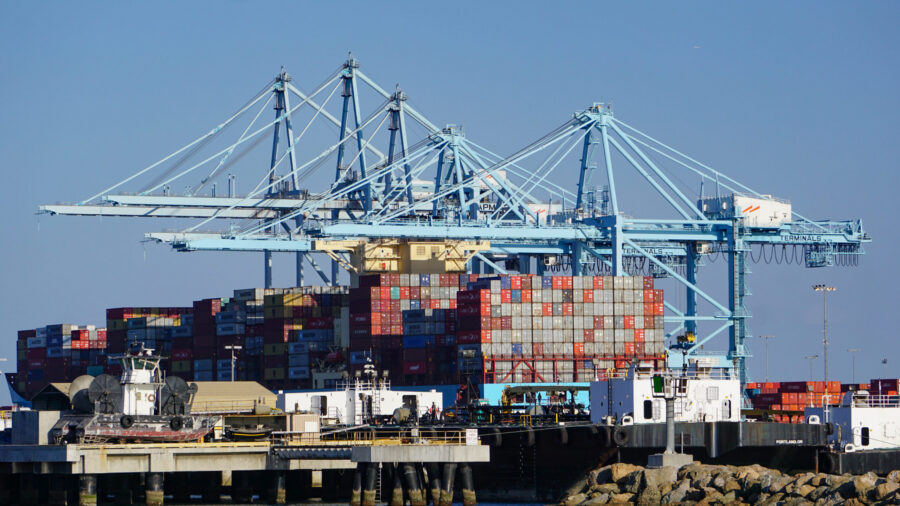
President Trump has temporarily suspended the Jones Act in order to bring down prices for oil in the United States, but since the administration can see how the Jones Act raises prices on Americans, they should consider scrapping it altogether. The Cato Institute’s Colin Grabow recently had a discussion with 60 Minutes’ Lesley Stahl on the state of the shipbuilding industry in the United States (it’s bad), and the Jones Act was mentioned. Grabow gave the Jones Act another airing on Cato’s website, writing:
Given their intertwined nature, it’s no surprise that the shipbuilding discussion included a mention of the Jones Act. After all, the law requires that vessels used in domestic water transportation be constructed in US shipyards. According to the Jones Act’s defenders, this helps bolster US shipbuilding. But given the industry’s enervated state, that’s an increasingly difficult case to make.
For well over a century, observers have pointed out that such protectionism has sapped the industry’s drive and competitiveness.
But the Jones Act has had considerable economic consequences as well. Jones Act-compliant ships are extraordinarily expensive to build, costly to operate, and few in number. This significantly raises the cost of water transportation. In some cases, the law eliminates it as an option entirely.
New England relies entirely on imported liquefied natural gas (LNG) to meet its energy needs. Although the United States is the world’s leading LNG exporter, New England cannot access domestic supplies because no Jones Act-compliant LNG tanker exists to transport the gas. And one never will. With the cost of building such a ship estimated at $1 billion—more than $700 million above the foreign price—the economics simply don’t work. Even the CEO of a company operating Jones Act-compliant tankers recently acknowledged as much.
This constraint extends beyond New England. Alaska cannot replace declining Cook Inlet production with LNG from its North Slope. Hawaii’s government has identified the Jones Act as a barrier to the state’s ability to access American natural gas. Puerto Rico, despite a partial exemption for LNG transportation, still faces limitations in sourcing natural gas from the mainland.
These are only the most glaring costs. The law’s distortions ripple throughout the US economy, from higher consumer prices in island communities to impeding domestic energy logistics.
This helps explain why the Trump administration recently issued a temporary Jones Act waiver amid mounting economic pressures and why 60 Minutes deemed the issue worthy of attention.
The case for reforming, and ideally repealing, the Jones Act has never been stronger. Whether the political will exists to act on it, however, is another matter.
Read more here.


