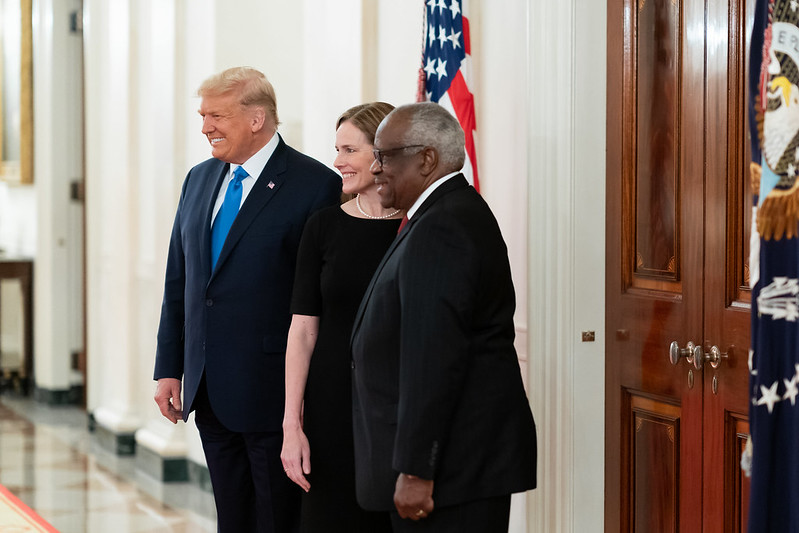
On Monday, the WSJ reports, the Supreme Court will begin its new term. Justice Clarence Thomas will complete his 35th year on that court. Should Justice Thomas complete another 19 months on the Supreme Court, he will break Justice William O. Douglas’s record as the longest-serving justice in history.
Douglas, nominated by President Franklin D. Roosevelt, served from 1939 to 1975. Thomas was nominated by President George H. W. Bush and is perhaps the most conservative member of the current court, writes Jason L. Riley at the WSJ.
In the Journal, Douglas is described as a flagrant liar, a compulsive womanizer, a heavy drinker, a terrible husband to each of his four wives, a terrible father to his two children, and a bored, distracted, not collegial, irresponsible, and at times unethical Supreme Court justice.
According to the retired appellate court judge and legal scholar Richard Posner, Douglas was “rude, ice-cold, hot-tempered, ungrateful, foul-mouthed, self-absorbed, and devoured by ambition; he was also financially reckless—at once a big spender, a tightwad, and a sponge.”
In contrast, Mr. Riley writes, Justice Thomas’s colleagues think of him as the kindest and most genial person in the building, someone who goes out of his way to get to know everyone from the custodial staff to the clerks of his fellow justices. “He is principled, plain-spoken, and known for his booming laugh. In the late 1990s, he and his wife, Virginia, took in his grandnephew, who was in danger of entering the foster care system, and raised him as their own.”
Longevity is not what ultimately distinguishes Thomas as a jurist, Mr. Riley insists.
It is how he has used his time on the nation’s highest tribunal. In his new book, “Going Further: The Incomparable Clarence Thomas.” Sen. Ted Cruz describes the justice as someone who has marched to his own drum and in the process become one of the most consequential jurists ever to serve.
“Justice Thomas has insisted that the text and original meaning of the United States Constitution, not past decisions of the Supreme Court or politics, should be the highest authority.”
Mr. Cruz writes. “There were times when this made him something of an outcast among his colleagues. But he never wavered. Indeed, no justice in our nation’s history has been more willing to overturn past decisions of the Court that were wrongly decided.”
Before Mr. Cruz was elected to the U.S. Senate from Texas, he spent more than a decade as a Supreme Court litigator. Before that, he clerked for Chief Justice William Rehnquist in the mid-1990s, the WSJ reports. The book does cover familiar ground about Justice Thomas’s hardscrabble upbringing and controversial Senate confirmation. Its most important contribution, however, is Mr. Cruz’s informed analysis of Justice Thomas’s jurisprudence and legacy, which he gleaned from hours of personal interviews.
On issue after issue, continues Riley, Justice Thomas’s lone dissents and his concurrences urging the majority to “go further” have resulted in the court ultimately following his path. Since the 1990s, Thomas has argued that although Supreme Court jurisprudence has been gutting the Second Amendment for two centuries, the amendment’s plain language clearly protects an individual’s right to keep and bear arms.
Thomas also argued, at least as long, that the only proper interpretation of the 14th Amendment was that the government can’t discriminate based on race, even when it is supposedly benign discrimination in the form of affirmative action.
With time, court majorities have come around to Justice Thomas’s reasoning on guns and racial preferences. “More broadly, even liberals on the court who reject originalism nevertheless take the text and history of the Constitution more seriously than they did in the pre-Thomas era.”
Ted Cruz believes Justice Thomas’s thick skin and stick-to-itiveness will be his most important legacy, no matter how much longer he serves. “He has endured seemingly unendurable hatred without becoming hateful himself,” Mr. Cruz writes. “He has lived a life defined not by ambition, but by duty. Most importantly, he has not changed his views simply because a majority of the country—or some political party—have changed theirs.”