Dear Survivor,
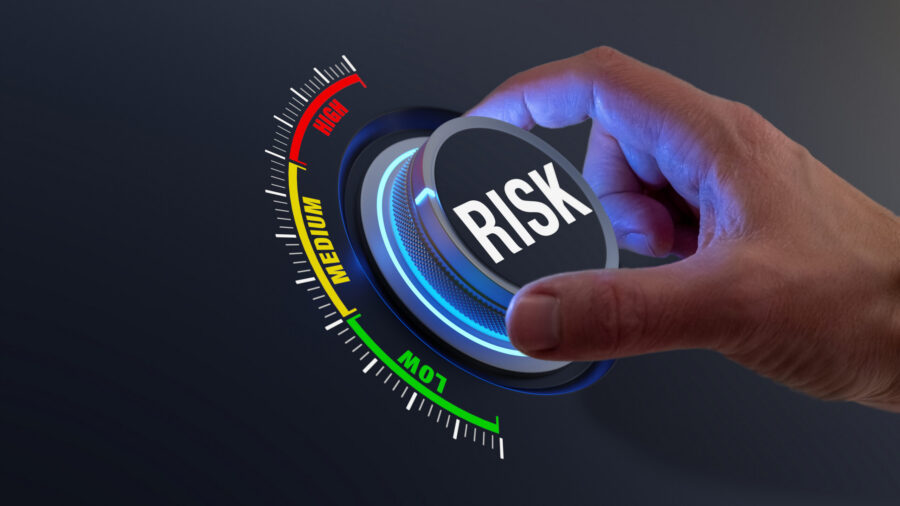
Risk, it means different things to different people. If you value your family. If you value keeping your family safe and properly sheltered, then the word risk isn’t something you take lightly. And yet when asked about money and investing objectively or for one’s objectives, it’s often phrased as something like: “I want capital appreciation and no risk.”
Great.
The whole idea of investing is to defer gratification, saving ‘til it hurts. In other words, you need to work. And yes, to invest in something that will help you accomplish your goals. Goals that align with your risk tolerance.
Unfortunately, that isn’t how it always works in the real world. Investors often invest in what they “know” will go up. And when it doesn’t, they scream the loudest because it didn’t go their way.
That’s life.
If you value your peace of mind, ask yourself or your investment manager if your investment portfolio matches your risk tolerance (or lack thereof).
Diversification
Done right, diversification can improve portfolio returns while lowering risk. That’s why Harry Markowitz, creator of the Efficient Frontier, called diversification the only free lunch in investing.

Why is it then, in my portfolio reviews of prospective clients, that I often encounter a handful of stocks? Because investors tend to sell the “losers” and keep the “winners.”
Not being diversified is like sailing a yacht on starboard tack, sails full, crew leaning over the side to reduce heeling when suddenly the wind dies, and everyone’s scrambling to the other side.
And that’s not to say it’s always the captain’s fault. That’s life on the water. It happens.
The same is true for life in the markets. Look at the trashing in private credit. These junk-bond-like products were stuffed into portfolios sold with promising historical returns. Then, returns slowed, investors wanted their money back, and guess what? Withdrawals are being restricted to a small percentage of their original investment. What did investors expect would happen?
In my conversations with you, our discussions on diversification have as much to do with you as they do with what to buy. “In the past,” I ask, “how did you handle major setbacks in the markets? Were you forced to sell to sleep well at night, only to miss the boat during the recovery?”
This is not a dig. I understand: Being invested and staying invested is not for the faint of heart.
On the flip side, it’s crazy how many positions some professionals stuff into portfolios. Talk about going too far in the other direction. The overlap and rats’ nest of holdings is all over the place. There’s no real meaning behind the portfolio other than “let’s see what sticks.”
You Know Diversification’s Best Friend Is Patience
You now know about diversification. How about its best friend, patience? Such a pretty word. Just rolls off the tongue, doesn’t it?
Not so much when you’re telling someone else to be “patient.” It’s like saying, “Why don’t you just relax?”
But without patience, compound interest, the seemingly magical formula of making interest on interest, is worthless. Without time, there’s not much to compound. Patience, in other words, is about giving something time and not rushing to decisions.
The phrase “hang in there” comes to mind. That’s another piece of advice often given to someone who’s frustrated, another incredibly difficult emotion to overcome when lacking inner fortitude.
It’s why you are so important to your success. If you can’t be patient, nobody else can do it for you. Being invested and staying invested isn’t for the faint of heart. Patience is a virtue because it’s not intuitive. It takes work.
You got this. You didn’t get here by being lazy. You did the work. Now see it through. When you want help, email me at ejsmith@yoursurvivalguy.com.
Survive and Thrive this month.
Warm regards,

“Your Survival Guy”
- If someone forwarded this to you, and you want to learn more about Your Survival Guy, read about me here.
- If you would like to contact me and receive a response, please email me at ejsmith@yoursurvivalguy.com.
- Would you like to receive an email alert letting you know when Survive and Thrive is published each month? You can subscribe to my free email here.
P.S. When speaking the word opportunity as a parent or grandparent to a child, let’s say, what is spoken and what is heard can be two different matters. An “opportunity” to you may be heard as a “you should do this” statement to another. Who likes being told what to do?
Your Survival Guy walked by the SSV Tabor Boy yesterday on one of my regular afternoon walkabouts. Seeing Tabor Boy brought back memories of sailing in the Caribbean my junior year at Tabor Academy. During the fall and spring, it was also offered as an after-school sport of sorts where you and 20 other students could work on her during the week and go on overnight trips on certain weekends.
I thought, “Self, that was a great ‘opportunity.’” But I know why I chose to play soccer and golf instead. Because growing up on the water with boats, I knew how much work it was in the spring and fall, prepping them for the season and putting them away for the winter. Why would I want to do that every day after school?
Which brings me to the stock market and you. When markets are booming (and wow aren’t they?), the investment business looks glamorous. But believe me, when there’s a bust (and there are), it’s not much fun at all.
When asked about the brutal 1970s, Fidelity CEO Edward C. Johnson III (Ned), also a Tabor Academy graduate, would later joke: Had he known it was going to last that long, he probably would have chosen another profession.
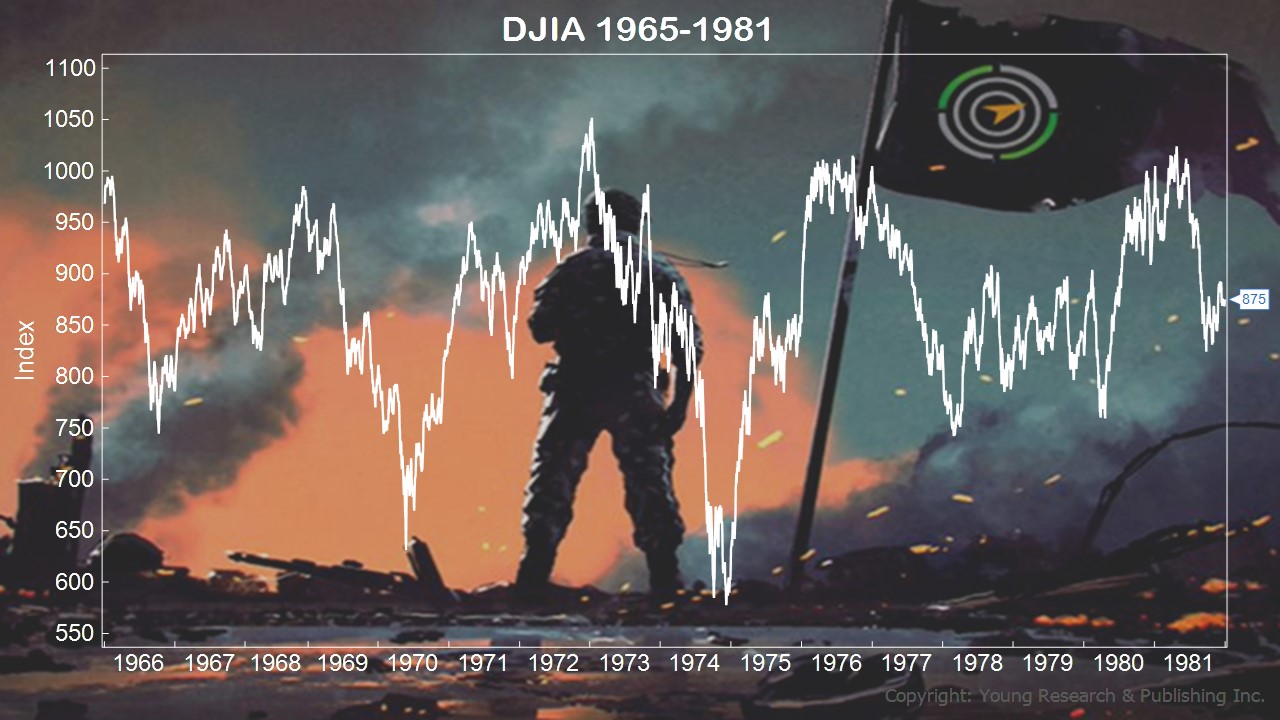
Let’s not confuse “opportunity” with reality.
I don’t think you were jumping around from one profession to a “hotter” one. Some years were great, some years not as good. But compounding small improvements (kaizen) can make a career a worthwhile opportunity.
P.P.S. You can see in the chart below the dramatic fall of coal as America’s primary source of fuel for power generation. After the Obama administration hammered coal with new regulations, and new natural gas sources were found in shale plays across America, many coal plants were no longer economically feasible.
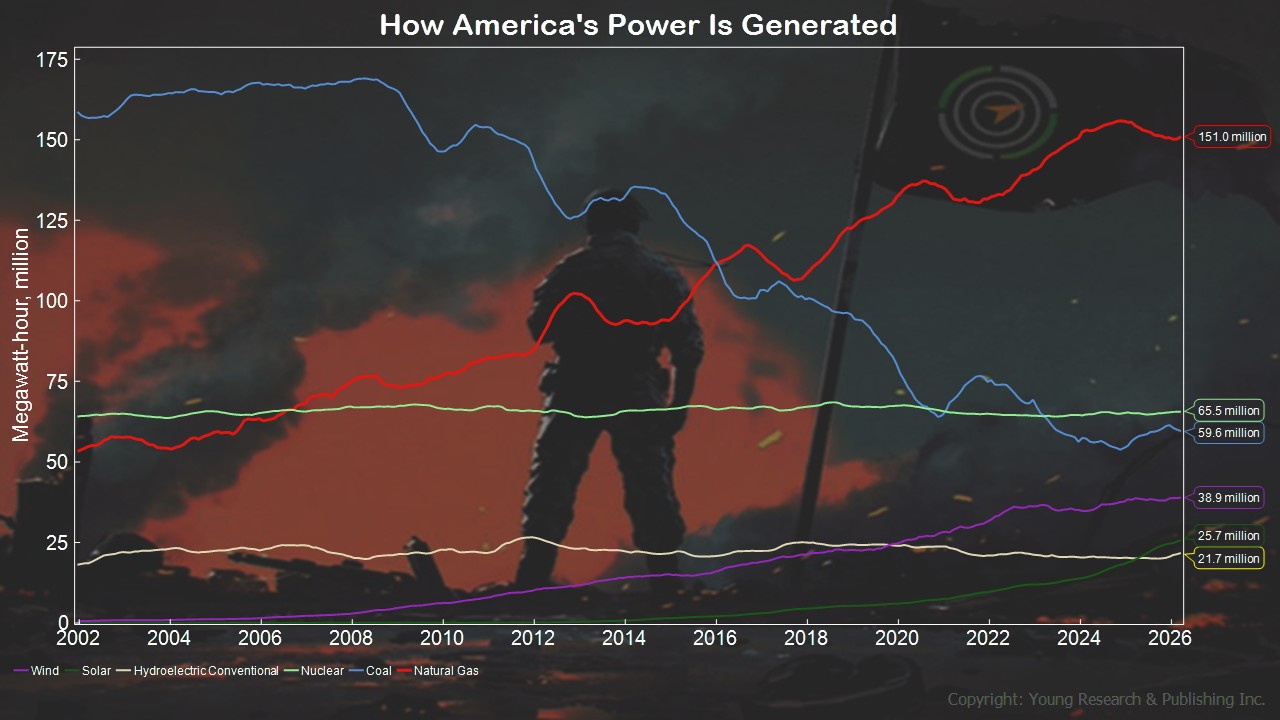
The other big movers on my chart are wind and solar, which have enjoyed massive subsidies and are growing rapidly as power generation sources in America, especially solar.
The two “Steady Eddies” of the American power mix are hydroelectric and nuclear. Hydro isn’t likely to grow much, given the obvious damage to the environment that damming up America’s big rivers does, and the lack of support for such a course.
Nuclear, on the other hand, has the potential to grow. If regulatory and permitting cost burdens can be reduced, nuclear power could very well see its renaissance, of which you have read a lot.
But all good things take time (like compounding), and in the immediate term, natural gas, and to a lesser extent coal, will probably feed America’s demand for power for artificial intelligence data centers.
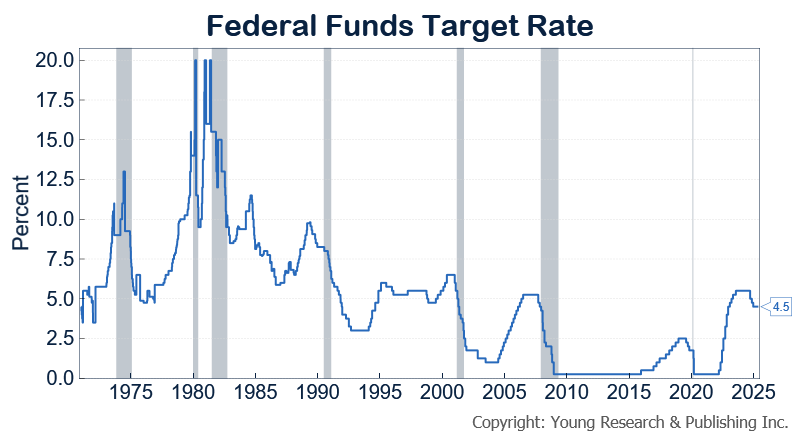
P.P.P.S. You may have seen Federal Reserve Chairman Kevin Warsh’s press conference on June 17, but if you didn’t, there are some things you should know.
One of the most welcome statements from Warsh was his answer to a question about the Fed’s “ongoing guidance” asked by Ed Lawrence of Fox Business. Since the Bernanke era of the Fed, there’s been a lot of focus on communication from the central bank about what it would do next. Speeches by Governors and Presidents would pre-signal the Fed’s intended actions, and markets would adjust ahead of the meeting to the expected outcome.
That was in stark contrast to what existed before Bernanke’s Fed. Before Bernanke, there was the recently deceased Alan Greenspan (RIP). Greenspan was a master of “Fedspeak,” or the ability to ambiguously discuss the economy and the Federal Reserve’s view of the economy without giving away any hints as to what the Fed might do next.
It appears that Chairman Warsh may return to employing Fedspeak, rather than pre-signaling every move the Fed will make. He responded to Lawrence’s question on guidance as follows (YSG’s emphasis added in bold):
So I think financial markets perform best when they react to incoming data. I think the financial markets work less efficiently when they ask a question. How will the Federal Reserve react to that incoming information? The more that markets are paying attention to what’s happening in the real economy, deciding what’s good data and what’s less good data, the more financial markets can price what they believe is the most likely and what are the tail risks. Financial market prices are probably the most important source of information to guide central bankers. But when all the financial markets are doing is reflecting back what we’ve said, then we’re taking the most important source of information and we’re being blind to it. I’d like us to create a system where those blinders come off, where markets are following data that they efficiently think is reliable. And they’ll be watching data, we’ll be watching data. They’ll come with better information through market prices to us, we can make more informed decisions. But ultimately, the goal that I said at the outset, deliver on the price stability objective that Congress told us to do, and that we’ve got to get in the business of doing.
Monetary policy can’t be a reaction to a reaction, caught in a cycle. It has to reflect the reality of the economy, and Wash is putting markets to work, figuring out the real economy rather than making bets on future Fed policy.
One area where Warsh’s messaging was unambiguous was his critique of the Fed’s recent failures on inflation. In response to a question from Chris Rugaber from the Associated Press on inflation, Warsh explained (again, my emphasis in bold):
So I can’t do much better than the committee just did, so let me restate it. Inflation remains elevated relative to the committee’s 2 percent goal, in part reflecting supply shocks that have driven price increases in certain sectors, including energy. That paragraph goes on to say, “But to be clear, the Fed will deliver price stability.” My own judgment is the committee spent quite a bit of time not just in two days but over iterations of a couple weeks. That’s what we’re prepared to say about inflation, but the commitment to deliver is strong, unanimous, and unambiguous. And that’s I think an important message we’ve missed for five years, and we’re going to fix that.
Warsh’s comments were an indictment of former Federal Reserve Chairman Jerome Powell’s failure to tame inflation faster, both during the Biden presidency and during the latest flare-up of inflation under President Trump. During Trump’s selection process, many pundits believe the President would nominate whoever promised him they would lower interest rates. But after Warsh’s performance, the market is looking for at least one quarter point increase in rates in 2026, and Bank of America believes there could be three. Watch closely.

Download this post as a PDF by clicking here.
Originally posted on Your Survival Guy.