

Imagine being able to afford not paying your monthly credit card bill, and simply adding the interest to the amount owed, and you can understand what’s happening with private credit PIKs. PIK is short for payment-in-kind and is an option embedded in loans that allows borrowers to pay back cash interest payments along with the principal at maturity, essentially deferring interest to the end of the loan’s life.
Such PIK options were popular when private lenders were eager to attract borrowers, but now that they are being used more often, lenders are growing weary of them. AnnaMaria Andriotis reports in The Wall Street Journal:
Some 13.5% of new private-credit loans originated in the second quarter had a PIK provision, according to investment-banking adviser Lincoln International, down from 25% at the end of last year.
Lenders have a little more negotiating power than they used to, said Brian Garfield, managing director at Lincoln International. “This is an evolution we are seeing unfolding now,” he said. “The pendulum is shifting.”
Lending standards have been tightening across the private-credit industry, the result of worsening loan performance and increased scrutiny from investors, including wealthy individuals who are rethinking how much they invest in private credit. Firms are extending less debt to borrowers being bought out by private-equity firms—especially software companies and others vulnerable to disruption by artificial intelligence—and are closing loopholes that allow financing against borrowers’ assets.
The Federal Reserve Bank of Boston has performed a study of payment-in-kind options. The study notes that while borrowers are using their PIK options more often, lenders aren’t compensating for the risk by raising rates, signaling that the private credit industry may be in a bit of a price war. The Fed paper explains:
Over the past two years, however, BDC spreads have narrowed by approximately 1 percentage point. Figure 5 shows this compression in median spreads since 2022. The compression likely reflects growing competition, as investors have poured capital into private credit strategies in search of higher returns. When more capital chases the same loan opportunities, spreads tend to compress.
The combination of rising PIK usage and compressing spreads presents a puzzle. If borrowers are increasingly unable to pay cash interest, lenders might be expected to demand higher compensation for bearing that risk. Instead, however, they are accepting lower compensation. This could be a form of implicit restructuring: lowering the cost of debt to reduce the probability of default. This pattern also could be consistent with lowering rates in response to an increasingly competitive market.
You can see in the charts from the Boston Fed below the rise in PIK usage by borrowers and the change in PIK usage by industry from Q4 2022 to Q1 2026.
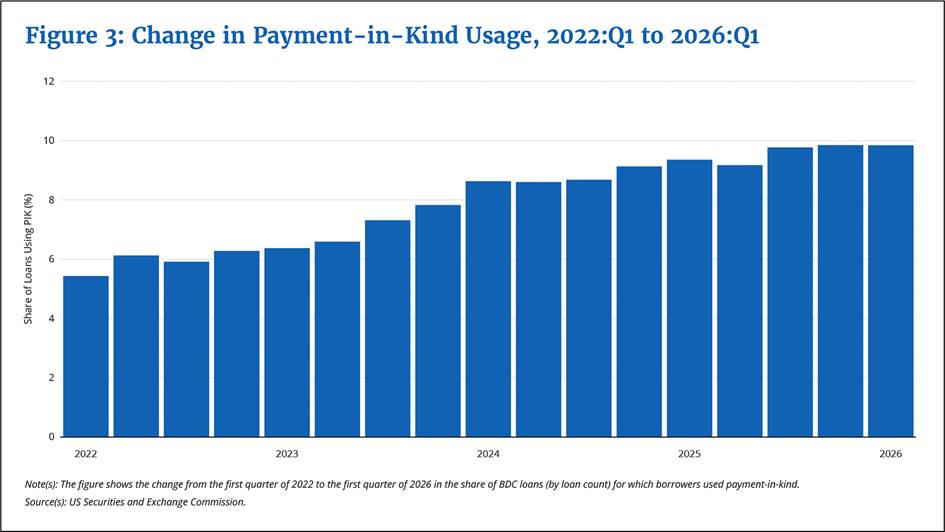
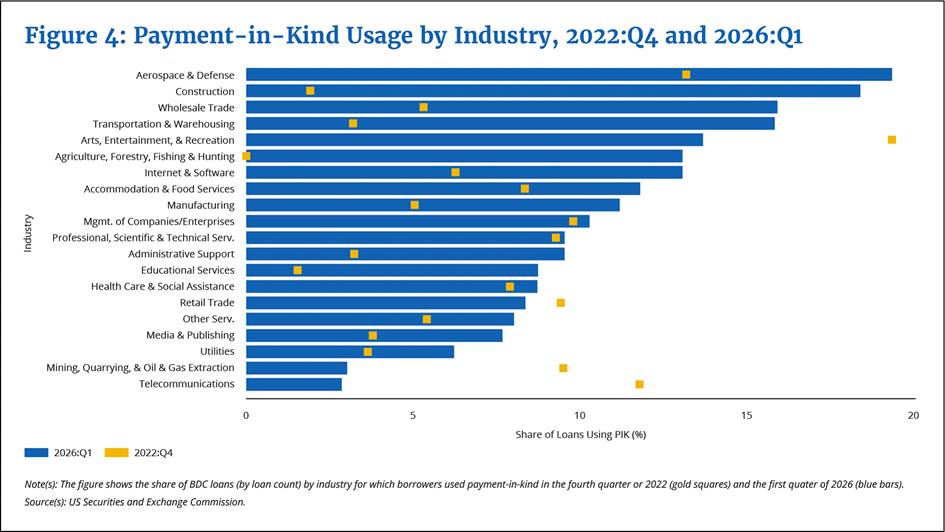 Not many industries are using PIKs less than they were four years ago.
It should be noted that the Boston Fed’s paper only covers business development companies, which have a higher level of required reporting to the SEC, while many other private credit lenders operate further from public view.
Action Line: So with borrowers so low on funds, investors unable to cash out their investments, and lenders suffering from narrower spreads, the private credit industry is caught in a bit of a vice, getting squeezed from all sides. Be careful if these funds show up in your 401(k). Lack of clarity and lack of liquidity are not desirable traits in a retirement portfolio. When you want to talk about your retirement portfolio, email me at ejsmith@yoursurvivalguy.com. And click here to subscribe to my free monthly Survive & Thrive letter.
Read the entire series here.
Originally posted on Your Survival Guy.


