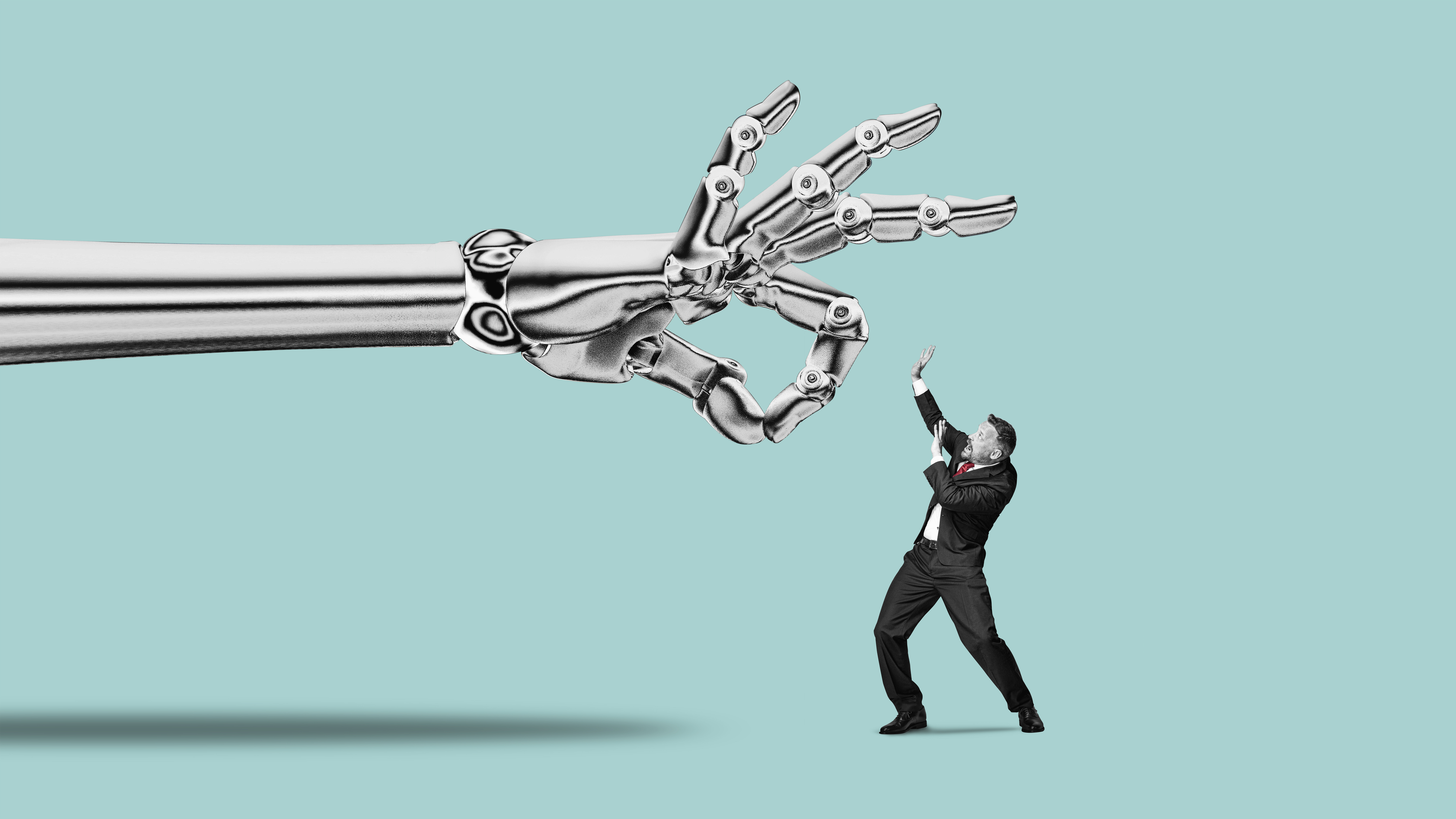
As AI seemingly emerged overnight, the impact and potential threats from AI became the leading issues in America’s politics. In American Greatness, Edward Ring makes a strong case that America must develop AI to maintain national security and stay ahead of China. Along the way, Mr. Ring emphasizes the need for data centers to minimize their environmental and community impact.
Ring brings up two serious questions that need to be addressed;
-
Will rogue or malevolently deployed AI exterminate humanity?
-
Will the data centers needed to develop AI overwhelm resources and destroy quality of life wherever they’re constructed?
An Existential Threat
Ring writes that the “consequences of how these questions are answered cannot be overstated. But the debate is almost moot, because, he continues, “if the United States doesn’t develop AI and the data centers required to support them as fast as it can, it will not be able to deter World War III. Period.”
The Trump administration recognizes a few simple but painful truths.
-
China is a fascist, expansionist superpower.
-
China’s allies include Russia, North Korea, and Iran.
-
For the last several decades, Chinese agents have been stealing every leading-edge technology from the U.S. they can get their hands on;
-
The Chinese have built a government-subsidized manufacturing base that dwarfs that of any other nation, and they are determined to surpass the United States in AI technology.
The Military Value of AI
It has completely transformed warfare, leaving legacy platforms obsolete. Without fundamental modifications and continuous innovation, multi-billion-dollar assets, from aircraft carriers to ICBMs, are obsolete.
The pace at which AI capacities advance continues Mr. Ring, means that, even if known new AI-enabled threats are addressed—for example, low-cost autonomous drones that can be released by the thousands in coordinated and precisely targeted swarms, or swarms of virtual AI agents launching cyberattacks against critical infrastructure—by the time countermeasures are developed, there will be a new generation of even more potent offensive AI technology.
None of this should be news, thinks Ring. “We are fighting another cold war.” Ring suggests that replacing ICBMs as the “instrument of mutually assured destruction,” politicians of both major parties are joined by pundits across the political spectrum who are propelling a populist wave of anti-AI sentiment.
People tend to forget, especially when at peace, how quickly we can slip from relative peace to total war. Ring uses Venezuela, Greenland, Cuba, the Panama Canal, Diego Garcia, the Strait of Malacca, most of South America, and, of course, Iran as examples of the catastrophic conflicts of WWII. Decades of disarmament and appeasement had enabled the Axis powers to acquire significant territory and resources. What might have resulted in far less bloodshed a few years earlier turned into the most devastating war the world had ever encountered.
Ring likens countries to pre-WWII examples, likening today’s China to Germany then; Russia is Russia; and Iran is 1936 Spain.
We have no choice, Edward Ring contends. America must build AI as fast as it can.
“The only thing we can reasonably expect to control is how we do it.”
Ring, perhaps not wanting to be too pessimistic, writes of “options” available.
Some of the CEOs of the biggest companies developing AI have called for a slowdown and more government oversight. This is a reasonable proposition, but it will undermine one of the biggest competitive advantages America has against China, which is our competitive startup culture.
For all we know, it could be an AI startup. There are thousands of them now in America that build the tool able to stop a runaway AI swarm that has escaped from one of the major players.
“Imagine,” continues Mr. Ring
-
if AI ends up heavily regulated, and starting in 2029 another Obama/Biden-type administration occupies the White House.
-
Imagine that every iteration of new AI capacity has to be approved by bureaucrats chosen for their ideological reliability and their identity as members of underrepresented groups.
Answering “how will data centers be deployed,” Mr. Ring is somewhat optimistic.
Recent innovations in closed-loop cooling technologies mean it is now possible to operate data centers with zero operating losses of water. Once they are primed, they will not consume any water. And as processor efficiency continues to improve, less electricity will be required. Eventually, data centers may be in orbit, where access to perpetual sunlight and the cooling properties of outer space will make their operations even more efficient.
Technology companies demanding more electricity from the U.S. grid is a healthy political development, notes Mr. Ring.
Instead of a totally unrealistic, quasi-suicidal energy rationing mentality, something that was dominant in the Obama/Biden era, we have lobbyists representing the most influential economic sector in America telling our politicians it’s time to build more electrical generating capacity. Good.
Instead of a totally unrealistic, quasi-suicidal energy rationing mentality, something that was dominant in the Obama/Biden era, we have lobbyists representing the most influential economic sector in America telling our politicians it’s time to build more electrical generating capacity. Good.
America has no choice. AI is here to stay. The risks to our future are far greater if we lose control of its direction, warns Edward Ring.
We must build it and stay one generation ahead of our enemies. And while it, in that way, will deter the next big war, it may also bring us wondrous and beneficial scientific breakthroughs, helping us cure diseases, eliminate poverty, and heal the planet.