
You know that evacuating is sometimes the best way to avoid a disaster situation. You should have a plan in place, and a destination that you can get to reliably but isn’t so close that it’ll also be in the evacuation zone.
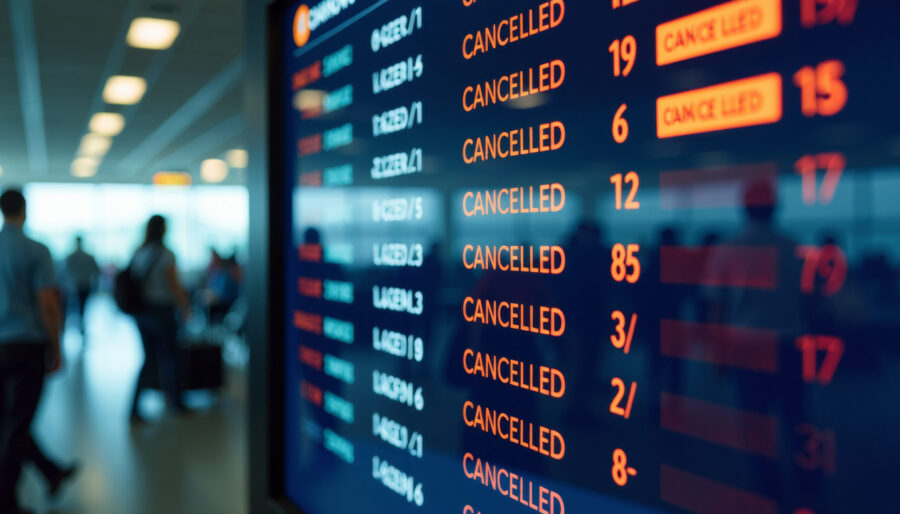
But sometimes, it’s not flight from home; it’s flight to home that’s the problem. On Friday, travelers across America were caught on their heels by a full ground stop of all flights ordered by the FAA. Transportation Secretary Sean Duffy explained the situation once the stop was lifted.
The nationwide ground stop lifted at 8:15pm ET.
Here’s a breakdown of today’s timeline:
– At 3:36 p.m. ET, @FAANews experienced telecommunications issues at facilities & TRACONs across the country
– The FAA issued a ground stop out of an abundance of caution while 3,500+ planes were in the air
– Pilots and air traffic controllers followed established procedures to safely land the aircraft, bringing the number in the airspace down to under 400 as of 8pm ET
– The FAA confirms they did not lose all radar or telecom, and exceptions were made to allow critical medevac, life-saving cargo, and law enforcement flights to continue operating— Secretary Sean Duffy (@SecDuffy) November 14, 2026
How Would You Respond?
The cause is not consequential. What is important is how travelers were able to respond to the unplanned cancellation or delay of their flights.
For many stranded travelers, trains were the first alternative, and perhaps unsurprisingly, the Amtrak booking website crashed when it was needed most. In response to customer complaints about the outage on X.com, Amtrak wrote:
We apologize for the error messages on both our website and app, as well as the difficulty reaching a representative. We’re currently experiencing higher-than-normal call volumes due to ongoing airline issues. Furthermore, we recommend trying again later. Thank you.
On Saturday morning, Amtrak followed up with:
Amtrak’s booking systems are returning to normal following a network outage. As service continues to be restored, some customers may experience intermittent issues when processing payments, booking new travel, or modifying existing reservations. Our call centers may also experience higher than normal call volumes, which could result in longer wait times. Our teams continue to monitor the systems and work toward full restoration. We appreciate your patience and understanding.
Planes, Trains, and Automobiles?
So when planes and trains don’t work, like a John Candy and Steve Martin movie, it’s time to move to automobiles.
Auto rental companies were inundated with rental requests. Some put out statements.
Hertz told Newsweek:
With flight disruptions impacting travelers nationwide, Hertz is seeing increased one-way rental activity as customers adjust their travel plans. Our teams are closely monitoring demand and working quickly to accommodate travelers and manage vehicle availability across our network as conditions evolve.
Enterprise Mobility gave Newsweek a similar statement:
We recognize flight disruptions can create unexpected challenges and stress for travelers. Our teams at Enterprise Rent-A-Car, National Car Rental and Alamo are focused on supporting travelers whose plans have been impacted, and we’re doing everything we can to assist customers based on local vehicle availability. We encourage customers to check our websites for the latest availability and location information.
What Do You Do?
Reports of scarce rental cars available, and hotel rooms filling up fast were widespread. So what can you do to help yourself in a situation like that faced by travelers on Friday?
The greatest problem faced by many travelers was getting caught during a layover. You’re not at home, and you’re not at your destination. You’re stuck. To mitigate the risk that could happen to you, there are options.
Your Survival Guy prefers flying private. If you can afford it, this is a more flexible option that can resolve issues faster.
If you can’t fly private, fly direct when possible. You can’t get stuck in a random city if you never stop there to begin with. Of course, direct flights are also more costly and rare for far-flung locations.
If you absolutely must stop for a layover, do some prior planning. Learn a little about your layover destination. Some things you should know ahead of time that can save you a lot of hassle later.
- Learn the layout of the airport and your terminal. Baggage claim, shuttle buses or trams, gate layout, food, etc.
- Where can you rent a car? Which companies serve that airport, and which would you prefer to use?
- Are there public transportation options that connect the airport to the city? Is it better to head to the city than to stay at the airport? What additional transport options are in the city?
- Are there hotels available next to the airport? Where would you want to stay?
- What’s the fastest route from your layover city to your destination if air travel isn’t an option?
- If you’re traveling internationally, can you legally enter the country where your layover is located? You don’t want to end up like Tom Hanks’s character in The Terminal.
Don’t Be the Last One to Have a Plan
Spending just ten minutes answering the questions above will put you light-years ahead of most of the other travelers you’d be stuck on the ground with. A plan you already have is much easier to execute than one you’re making up on the fly.
Speed of execution can reduce the risk that you’ll be left with no car rental, or no train ticket, or no hotel room. Options will narrow quickly; you don’t want to be the last one to have a plan.
Prior Planning Reduces Investing Risk
Investing without a plan is also a risk. Having a plan before market volatility hits reduces the risk you’ll be left without options.
Action Line: When you want to talk about a plan for your investments, email me at ejsmith@yoursurvivalguy.com. And click here to subscribe to my free monthly Survive & Thrive letter.
Originally posted on Your Survival Guy.


