
At the Cato Institute, Tad DeHaven discusses the Trump administration’s aggressive industrial policy, which has so far included acquiring stakes in a number of companies. Is it right for the American government to commandeer the country’s means of production? DeHaven explains:
The first Trump administration ushered in a new era of industrial policy, attempting to reshape the macroeconomic landscape through the use of tariffs. The Biden administration built upon its predecessor’s interventions, championing massive subsidies for the semiconductor and green energy industries. In his second term, Trump has raised the tariff ante and taken an alarming step further by directly inserting the federal government into the corporate boardroom.
Over the past six months, the administration has unilaterally engineered a series of deals that give the federal government ownership stakes in a portfolio of private companies. It’s a seismic and disturbing development in federal policymaking—and it’s not done. Congressional Republicans, who would be foaming at the mouth were this occurring under a Democratic administration, have thus far chosen to sit on their hands.
Here’s a quick recap:
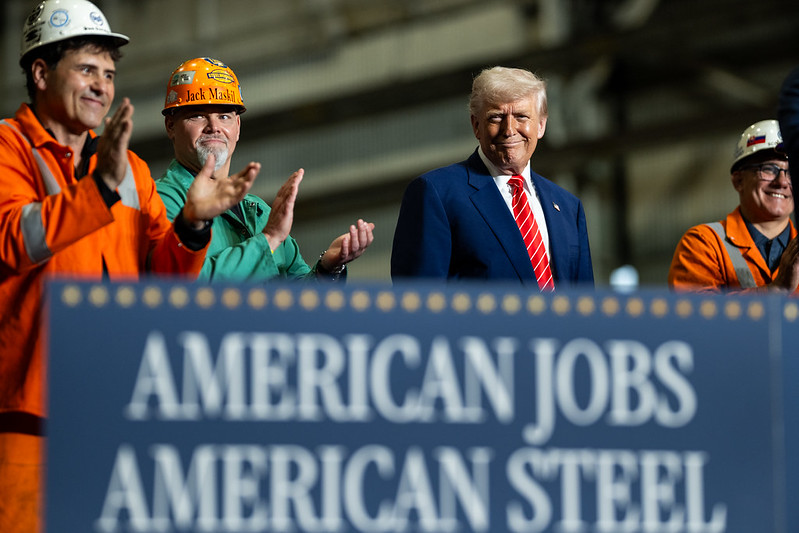
- June: Trump issues an executive order allowing Japan’s Nippon Steel to purchase U.S. Steel in exchange for a “golden share,” giving the president extensive control over U.S. Steel’s operations.
- July: The government becomes the largest shareholder in MP Materials, a company that produces rare earth metals.
- August: The administration announces that the government is taking a 10 percent equity stake in Intel, becoming the storied American semiconductor company’s largest single shareholder.
- September: An equity deal is reached with Lithium America, including a share of its joint venture with General Motors on the Thacker Pass lithium project in Nevada.
- October: The U.S. acquires stakes in Canadian-based Trilogy Metals, inserting the government into a joint venture with Australia’s South32 to develop the Ambler mining district in Alaska.
- October: A deal is reached with the Canadian owners of Westinghouse to finance nuclear reactors in exchange for the government receiving a share of future profits, with an option to require an initial public offering of Westinghouse and convert the profit share into a 20 percent ownership stake.
- November: The U.S. acquires stakes in rare-earth magnet manufacturer Vulcan Elements, alongside a complementary agreement with rare-earth processor ReElement Technologies that includes warrants giving the government the right to buy stock later.
Last week, the White House announced a preliminary agreement to acquire a stake in xLight, a startup developing technology to enhance extreme ultraviolet lithography machines used in the manufacture of advanced semiconductor chips.
Trump administration officials have made it clear that more deals are forthcoming. Potential targets include defense contractors, quantum-computing companies, and, according to Reuters, “deals across up to 30 industries, involving dozens of companies deemed critical to national or economic security.”
Read more here.


