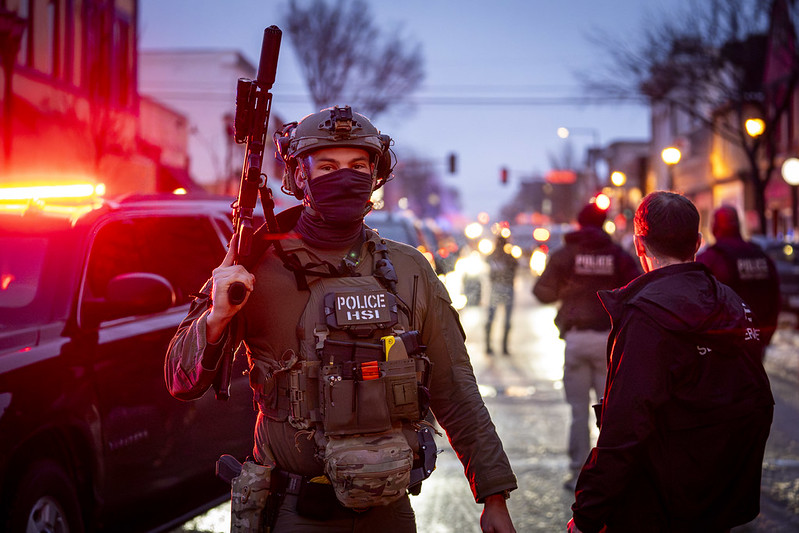
ICE, Minneapolis, and the Rule of Law
Last week, after an ICE agent shot and killed a civilian who was driving her car in his direction, Mayor Jacob Frey demanded that ICE “get the f— out” of Minneapolis.
“Whatever the politics of all this, the legal merits are strongly on the administration’s side,” writes Mr. George Terwilliger III, a Washington lawyer who also served as deputy U.S. attorney general, 1991-93.
The notion that a city makes itself a “sanctuary” by welcoming, embracing and protecting illegal aliens who are violent criminals does violence to the English language and to innocent residents trying to live and work there in peace. Mr. Frey, along with state and local officials and community “activists” in other “sanctuary” cities like Chicago and Portland, Ore., accuse the Trump administration of abandoning the rule of law, while they themselves flout the law by encouraging civilians to interfere with federal law-enforcement operations and ordering the local police to stand down.
“The deportation initiative is comfortably within the rule of law,” continues Terwilliger.
ICE agents’ presence in Minneapolis is undoubtedly lawful and consistent with the constitutional division of power between states and the federal government. Congress has enacted “necessary and proper” laws (under the Constitution’s Article I, Section 8) that govern when and under what circumstances aliens may enter or remain in the U.S. The ICE agents’ purpose in Minneapolis is to exercise that lawful authority as they carry out the constitutional mandate (in Article II, Section 3) that the president “take Care that the Laws be faithfully executed.” Neither the Constitution nor any statute provides cities and states any authority over immigration matters, rendering sanctuary-city policies legally feckless. They exist only because some officials are willing to exploit the presence of illegal aliens for political gain.
And More …
The Constitution’s Supremacy Clause (Article VI, Clause 2) forecloses Mr. Frey and his fellow exploiters from directing how ICE and any other federal enforcement officials perform their duties, continues Mr. Terwilliger in the WSJ.
Chief Justice John Marshall ruled in McCulloch v. Maryland (1819) that “the states have no power . . . to retard, impede, burden, or in any manner control, the operations . . . vested in the general government.” These aren’t abstract legal theories; they are fundamental precepts of our federalist system.
Stephen Soukup, in American Greatness, writes of normal, average, everyday men and women desperate for community, desperate for belonging, and desperate to make heroes of themselves for all the world to see and revere.
They “get involved” to be part of the in-group and “take a stand” for what they have been convinced is important.
Rather than ratchet up the rhetoric, advises Mr. Terwilliger, “state and local officials have a responsibility to dial it back and make clear that if the rule of law is to prevail, no level of government can tolerate efforts to impede and interfere with lawful government functions.”