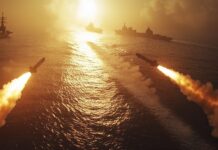
James Holmes of The National Interest writes that despite significant military gains in Operation Epic Fury, the United States and its allies are unlikely to secure lasting peace with Iran through air and naval power alone.
Drawing on Carl von Clausewitz, the analysis emphasizes that true victory requires breaking both an adversary’s capabilities and its will—something Iran has not demonstrated.
Historical examples suggest that without regime change or a stable, broadly accepted postwar order, conflict may endure or reemerge. The article concludes that only a decisive outcome, potentially involving internal change in Iran, could produce lasting regional stability. Holmes continues:
It’s a truism in military circles that the foe gets a vote in the success or failure of your strategy—and will cast it in the negative. The Islamic Republic of Iran has cast its vote against the United States’ wrapping up Operation Epic Fury, the air and naval campaign against the Islamic Republic, very soon. Sure, the joint US-Israeli leadership could declare victory and halt the campaign, content to have set back Iranian aspirations to regional hegemony and nuclear-weapon status. That is not nothing—far from it. But it’s doubtful such an outcome would translate into lasting peace in the Persian Gulf region.
Carl von Clausewitz, the sage of 19th-century Prussia, would nod knowingly at this strategic quandary. Clausewitz depicts martial strength as a compound of physical power and the resolve to use it. A combatant’s “power of resistance,” he writes, “can be expressed as the product of two inseparable factors, viz. the total means at his disposal and the strength of his will” (his emphasis). In other words, strength is a product of multiplying those two factors—not adding them. A strong combatant is both powerful and resolute. […]
To name a Persian Gulf-related example of fairly recent vintage, think about Saddam Hussein defying UN sanctions, weapons inspections, and no-fly and no-drive zones for over a decade after a coalition crushed his army in Operation Desert Storm. It ultimately took an invasion 12 years later culminating in regime change in Baghdad—and a gruesome death for Saddam—to finally bring a lasting end to the First Gulf War. […]
So let’s wish US and Israeli aviators and rocketeers—and their potential Iranian allies on the ground—the best of good fortune. Military victory is the only plausible route to regional harmony.
Read more here.