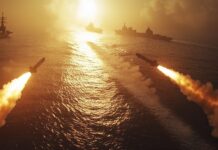
Variants of Iran’s cheap, long-range Shahed suicide drone have dominated the skies over Russia and Ukraine for years, and now the skies over the Middle East. Behind the variants used by Russia and Iran itself is a Chinese component supply chain. Austin Ramzy reports in The Wall Street Journal:
In early July, terrifying shrieks were heard across Kyiv. As part of a wider attack on the Ukrainian capital, Russia had launched cheap one-way drones powered by turbojet engines instead of propellers.
The Shahed drones, now more like missiles, were capable of flying up to around 300 miles an hour—roughly three times as fast as older versions. Some 30 people were killed in the attack, which also included ballistic and cruise missiles.
It was the latest innovation in one-way attack drones and, like others, it only became possible thanks to China, whose factories provided the engines, according to Ukrainian officials who examined some of them.
In a guidance document to industry, the State Department noted “third-country suppliers” as the source of the components in Iran’s Shaheds. They wrote:
Iran relies on foreign procurement to obtain items it cannot produce domestically, often preferring U.S.-origin technologies. Recovered Iranian-origin UAVs used by Russian forces in Ukraine reveal that Iran’s UAV program has used many components produced by third-country suppliers. Industry should be aware of its compliance obligations due to the threat posed by the extensive overseas network of procurement agents, front companies, suppliers, and intermediaries Iran uses to obtain UAV components, all of which employ a variety of methods to evade export controls and sanctions. Industry should exercise extra vigilance due to the ubiquitous nature of many of the items, as Iran utilizes commercial-grade components in its weapons.
The following list highlights key commodities sought by Iran for its development of UAVs.
Electronics, such as transceiver modules, processors and controllers, memories, amplifiers, and other electronic integrated circuits. Most notably, Iran relies on certain U.S.-branded items such as field programmable gate arrays (FPGAs), RF transceivers, microcontrollers, and capacitors. Some of these are low-technology items and may not be included on the Commerce Control List (CCL)1 of the Export Administration Regulations (EAR, 15 C.F.R. Parts 730-774) (i.e., they are designated as “EAR99”) but nonetheless may be controlled for export to Iran under U.S. sanctions or export controls.
Guidance, Navigation and Control Equipment, such as accelerometers, gyroscopes, inertial measurement units (IMUs), and other navigational sensors.
Components, such as aircraft spark-ignition and compression-ignition internal combustion piston engines and associated spare parts, and modules such as flight computers.
Figure 1. Recovered Iranian UAV containing components classified under harmonized tariff schedule codes listed in supplement no. 7 to 15 CFR part 746 (see section on U.S. Export Controls below)
Exporters, manufacturers, and distributors of items listed above should be aware of the importance of carrying out customer due diligence in a way consistent with BIS’s “Know Your Customer” Guidance and Red Flags2, and should track to whom they are selling and/or shipping their items. We urge manufacturers that supply UAV-relevant items to establish multiple methods to track such items due to the observed prevalence of methods used to obscure the sources of components found in Iranian UAVs, such as the lasering off of serial numbers and other identifying information.
Artwork by Steve Schneider
Originally posted on August 4, 2025.
If you’ve received a birthday card from Your Survival Guy, then you know how neat the...