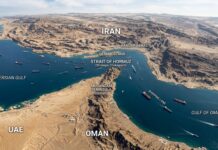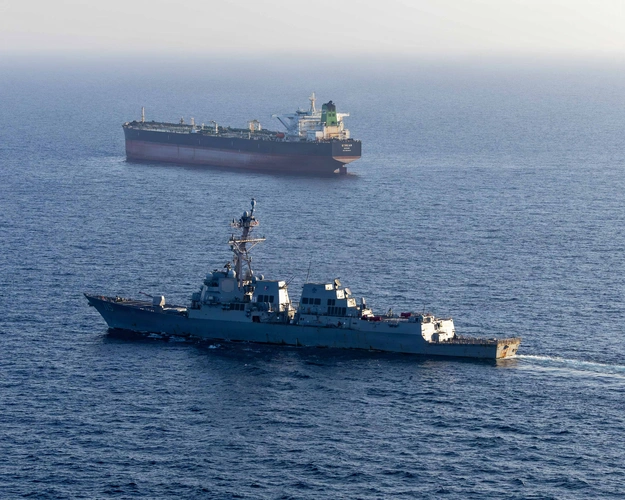
Kimberley Strassel discusses with Seth Jones, president of the Defense and Security Department at the Center for Strategic and International Studies, what President Trump’s Operation Freedom means for the Strait of Hormuz and the world.
It’s a humanitarian plan for US military forces to start guiding trapped commercial ships out of the Strait of Hormuz. On Monday, the US military successfully guided two US flagships through the Strait. Iran responded, or at least we assume it is in response to this, by firing missiles at warships and commercial vessels, and it also attacked a United Arab Emirates oil port.
President Trump has warned that if Iran interferes with this operation, which it seems very clearly to be doing, he will respond forcefully. The operations, though, seems to have already borne fruit, as the President has put it on “pause” in response to “great progress” in the Iran negotiations.
KS asks Seth about Operation Freedom, curious about his view.
Is this the beginning of the US reopening the Strait and ending Iran’s blockade, or is it simply the US pressuring Iran to get more serious about talks? How do you read this?
Seth Jones thinks the administration would certainly like to pressure the Iranians to begin having more serious discussions, particularly on a nuclear deal, including uranium enrichment, but also opening up the Strait of Hormuz.
I mean, I think having talked over the last few weeks with a number of Navy flag officers that have gone through the Strait over the past couple of years, the US Navy, with all the, not just the destroyers or cruisers, but also A-10s, MQ-9s, and other drone assets, space-based capabilities could force open the Strait (The US does have those kinds of capabilities). Yes, there is some risk. The Iranians still have anti-ship cruise missiles and some fast attack boats. They do have mines that are likely in the water.
Seth tells KS that part of the issue is going to be how much risk the president is willing to take to forcibly open the Strait.
Kim has a “side question.”
How much risks are the ships in question may be willing to take?
Seth, on his toes, answers KS.
Seth talked to the CEO of an insurance company last week, and explains:
“Part of their concern is supporting and insuring ships going through when both sides of the conflict, the US and the Gulf States and the Iranians are not yet agreeing on protecting ships going through. That makes a lot of ships nervous and shipping companies nervous. It makes insurance companies nervous. So frankly, I think what it’s going to eventually take is some kind of a deal that’s agreed to and announced where the Iranians are not going to conduct a tax. The US will agree and probably others agree to help guide ships through. But as long as we’ve got a situation which exists right now where all parties are not willing to support ships going through, I think it’s making shipping companies and insurance companies nervous. That’s the reality.”
Kim notes the uncertainty with the Trump insurance aid plan that he was putting together. Is it actually going to come to fruition?
“But speaking of other parties, could this also be viewed, is this another opportunity for other countries to come and help with this? Do you think that we’re going to get any additional nations lending a hand in this operation?”
Seth Jones: “Other countries are more willing, unfortunately, to aid once it becomes clearer that the Iranians aren’t going to shoot at them.” He continues:
“So I think as long as there’s a possibility of either mines in the Strait or particularly anti-ship cruise missiles or some of the fast attack boats, as long as that’s still a threat, I still think with European countries, some Gulf states, there’s going to be nervousness on putting their naval ships into the actual Strait of Hormuz as opposed to sort of at the mouth of it. So I think that’s what’s causing some of the concern right now.”
Kim points out how Trump refers to. She wonders if Seth thinks that Trump’s use of “humanitarian” has anything to do with the debate that’s been going on back here in the US about the War Powers Act and arguments mostly among Democrats, “among some nervous Republicans or institutional Republicans saying the president cannot carry on with military operations for more than 60 days without congressional approval.”
The White House, like former White Houses, says Ms. Strassel, has insisted the War Powers Act isn’t constitutional, but do you think that’s played into the way this has been phrased or is being operated? Is there anything to do with the debate that’s been going on back here in the US about the War Powers Act, and arguments mostly among Democrats, points out Ms. Strassel, and “among some nervous Republicans or institutional Republicans saying the president cannot carry on with military operations for more than 60 days without congressional approval. The White House, like former White Houses, has insisted the War Powers Act isn’t constitutional, but do you think that’s played into the way this has been phrased or is being operated?”
Seth Jones admits it is possible. “Yeah, it’s definitely possible. I mean, the challenge (the blockade) is typically in military terms.”
Jones continues to explain to Ms. Strassel that the more the blockade sounds like it is being done for humanitarian reasons, and you’re bringing in food stuffs or medical assistance or other things along those lines, or letting them out, then Seth indicates it starts to deflect some of the criticism that it’s only for military operations.
“I suspect that’s probably what’s being done.”
Read more of the Strassel interview at the WSJ/Opinion Page, where Ms. Strassel interviews Seth Jones on her WSJ show.