
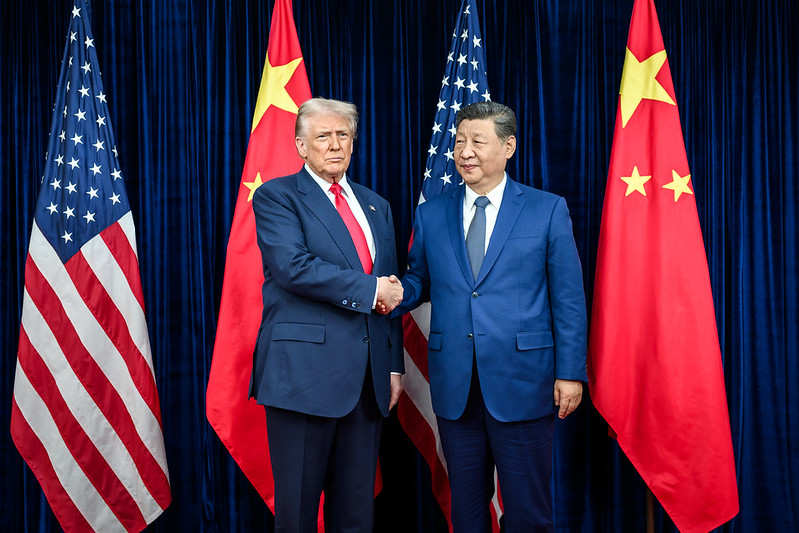
In May, President Donald Trump will meet with Chinese President Xi Jinping in Beijing, China. The Wall Street Journal notes that Trump has toned down his National Defense Strategy’s view of China, describing it as “conciliatory.” The WSJ notes that Trump’s tone has changed from his first term, explaining:
When Pentagon officials last fall briefed President Trump on a draft of a bureaucratic defense strategy document, it framed China the same way it had for a decade: as the top security threat facing the U.S.
Trump balked and ordered his Pentagon deputy to rewrite it, according to three officials familiar with the exchange. When the administration’s revised National Defense Strategy published in January, it offered instead a conciliatory tone toward Beijing.
“President Trump seeks a stable peace, fair trade, and respectful relations with China,” an unclassified version of the document declares.
While every administration crafts its own defense strategy, Trump’s second is making the unusual move of discarding a policy that was formulated by his first. That bipartisan approach sanctioned by Trump 1.0 characterized China as the most consequential U.S. adversary.
The Trump 2.0 framework is instead a seismic shift in U.S. policy, trade practices and rhetoric toward Beijing driven by a new mantra: Don’t rock the boat.
Despite what the WSJ sees as a new course on China, Trump himself revealed on Truth Social this morning an apparent attempt to make China pay more oil, and slow Chinese progress on the world stage with his Venezuela and Iran interventions. Trump posted an article from JustTheNews.com with the introduction “Trump upends China’s lucrative sanctioned oil import scheme after Iran, Venezuela interventions.”
The article, by Steven Richards, explains:
For years, China relied on exploiting U.S. sanctions to import steeply discounted oil from pariah states like Iran and Venezuela to fuel its economy and military buildup. Now, President Donald Trump’s interventions against both Caracas and Tehran have upended this lucrative arrangement.
China is suddenly confronted with a very different strategic calculus ahead of a key meeting with the American president in Beijing tentatively scheduled for next month. “I think it’s really China that all of this is centered on a grand strategic calculus,” Brent Sadler of the Heritage Foundation’s Allison Center for National Security told the Just the News, No Noise TV show, referring to the Iran war and intervention in Venezuela.
“Before [the Venezuela operation at] Christmas last year, China was the beneficiary of a lot of cheap oil in terms of trade that it dictated. Now over 20% of its oil that it imports, it’s going to have to pay a fair market price, greatly higher than what it did before,” Sadler said. “[And], oh, by the way, their foe in D.C. is the one that controls it.”
Sadler said that these moves deliver a strong message to China ahead of the likely summit between Chinese President Xi Jinping and his American counterpart.
Read more here.


