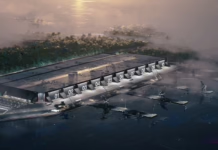
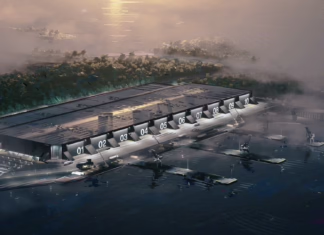
The International Institute for Strategic Studies (IISS) report Boomtime at Bohai: China Ramps Up Submarine Production highlights a sharp acceleration in China’s nuclear-powered submarine construction, fueled by expanded capacity at the Bohai Shipbuilding Heavy Industry yard in Huludao. From 2021 to 2025, China launched an estimated 10 nuclear submarines totaling roughly 79,000 tonnes, surpassing the 7 submarines (~55,000 tonnes) launched by the United States during the same period.
This surge represents a dramatic shift from 2016–2020, when China trailed the US in submarine production. The expanding Chinese fleet includes both ballistic-missile (SSBN) and attack/guided-missile (SSGN/SSN) submarines, with the upgraded shipyard enabling multiple vessels to be built simultaneously.
While the US continues to maintain a larger and more technologically advanced submarine force, China’s increased output is reshaping the undersea balance of power, presenting strategic challenges for American and allied naval planners. The IISS writes:
China has significantly increased its nuclear-powered-submarine production rate over the last five years (2021–25) while at the same time expanding its shipbuilding facilities. This output is greater than during the prior decade (2011–20), in which seven boats were launched. During the recent period, China, for the first time, launched more boats than the United States, with a greater combined tonnage (see Figure 1). Most significantly, this includes the seventh and eighth Type-094 (Jin) nuclear-armed ballistic-missile submarines (SSBNs), which come as part of the emergence of Beijing’s nuclear triad. […]
In 2023, the US Navy published a shipbuilding plan that proposed achieving a ‘1+2’ output, wherein one Columbia-class SSBN and two Virginia-class SSGNs would be delivered each year by 2028. If, as suggested by available imagery, China launched a Type-094 SSBN and two Type-093B SSGNs in each of 2024 and 2025, Beijing has now achieved a 1+2 production output. It is important to note, however, that US submarines are significantly larger and more sophisticated than Chinese designs, making them more challenging to build. […]
The ongoing replacement of the JL-2 (CH-SS-N-14) submarine-launched ballistic missile with the longer-range JL-3 (CH-SS-N-20) offers a partial solution to this problem, as it allows the Type-094s to target the western continental United States from the South China Sea. A new SSBN design, the Type-096, is still expected to begin production at Bohai this decade, entering service either in the late 2020s or early 2030s.
Read more here.