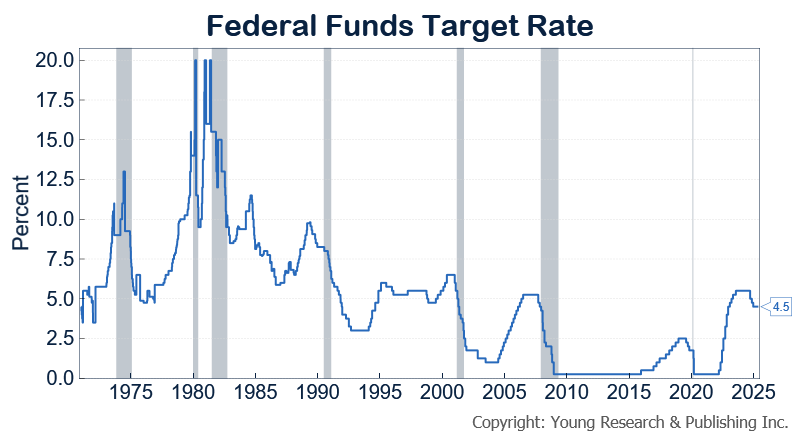
The market is betting heavily that the Federal Reserve Open Market Committee will cut the federal funds rate at its upcoming meeting, and the Fed has signaled it will do so. But whether or not the Fed does cut rates is not the same as whether or not the Fed should cut rates. At the Cato Institute, Jai Kedia suggests that the economic data do not support a cut at this time. Kedia writes:
To be clear, the point of this article is not to advocate any specific rate decision. In isolation, a minor change to the FFR will neither meaningfully help nor hurt the economy. As our prior work has shown, monetary policy is not as important as other market forces, and the Fed does not really control interest rates, let alone macroeconomic outcomes like inflation. In fact, mortgage rates fell last week, well before the upcoming FOMC meeting. Nor should people expect the Fed to save the economy from the negative effects of bad economic policy, especially supply shocks like tariffs that raise both inflation and unemployment, giving the Fed contrasting signals.
Rather, the point of this article is to highlight how our current predicament exposes flaws in the monetary policy framework. The primary such flaw is the lack of any objective standard to gauge what the “optimal” value of the FFR is. Ample research has shown that monetary policy rules offer the best policy prescriptions and are likely the best-case scenario for a world with a central bank. (Of course, there are several private market-based currency provision alternatives in a world without a central bank.)
The best guess, then, for the optimal value of the FFR is the value computed by using such rules. While there are numerous rules the Fed could follow, one example is the Taylor rule: an equation that relates the Fed’s policy rate target to its dual mandate macro indicators (inflation and unemployment). Using the most recently available data, the Taylor rule suggests the Fed’s current target is roughly correct. The following equation is a simplified Taylor rule:
FFRt = 0.8 x FFRt‑1 + ( 1 — 0.8 ) x [ 1.5 x Inflationt — 0.5 x ( Unemployment Ratet — NAIRUt ) ]
The current value of the FFR is 4.33%, and the latest annualized 3‑month CPI inflation was 3.5%. Using August’s unemployment rate of 4.3% and a 4.32% natural rate (NAIRU), the implied current FFR should be:
FFRSept 2025 = 0.8 x (4.33%) + 0.2 x [ 1.5 x (3.5%) — 0.5 x (4.3% — 4.32%) ] = 4.52%
Given that the FOMC’s current target range for the FFR is 4.25 to 4.5%, a standard rule advises no change or maybe even a 25 basis point increase to this target. It certainly does not advocate the rate cut that markets and analysts expect. But the way the Fed sets these expectations is another major flaw and could also be fixed by following a rule.
Read more here.