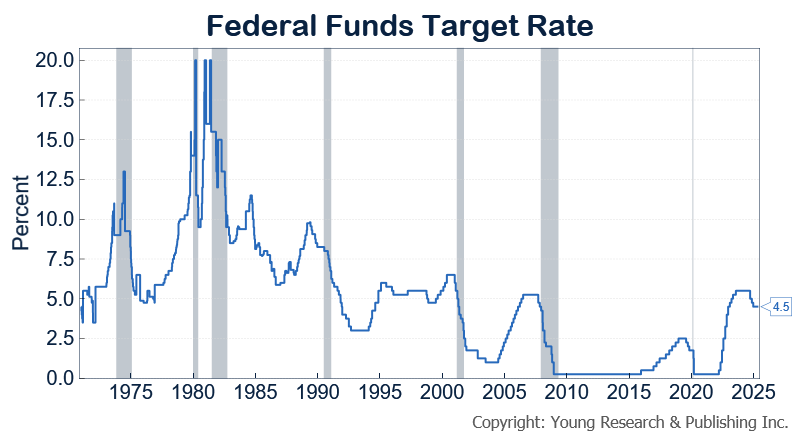
At the Cato Institute, Jai Kedia explains the benefits of a rules-based Federal Reserve, though, of course, the best reform to the institution would be to end the Fed. Kedia writes:
The best way to judge the Fed’s performance is to compare its rate decisions to those prescribed by common monetary-policy rules.
For instance, most common rules recommended the Fed raise rates beginning in late 2020, well before the central bank did so in January 2022, by which time inflation had become entrenched. Postpandemic inflation is not an isolated example. Academic research has shown that macroeconomic outcomes are better when the Fed follows a rule than when it acts discretionarily.
The good news is that, by committing to rules-based monetary policy, the Fed can both improve its macroeconomic performance and shield itself from political attacks. Under such a framework, the Fed would publicly announce its formula to determine the appropriate value of its key policy interest rate — the federal-funds rate (FFR). Most monetary policy rules function as feedback systems, guiding the Fed’s FFR target based on the current state of key macroeconomic indicators such as inflation and unemployment.
Given the economy’s interconnected nature and the tendency of these indicators to move in tandem, the policy recommendations from different rules tend to be similar. Indeed, the data bear that out. The potential macroeconomic-stability benefits from most common rules are similar, and all of them are better than pure Fed discretion. Arguments over which specific rule the Fed should follow should not stand in the way of committing to a monetary policy rule.
Unsurprisingly, the Fed disagrees with a rules-based approach. It has argued against such an approach in the past, though it has not made a persuasive case. This is despite the Fed often taking credit for the Great Moderation period from the 1980s through the early 2000s, marked by stable inflation and unemployment.
Interestingly, this is the same period where the Fed seemed to (unofficially) follow a rule. The criticism most often levied at rules-based monetary policy is that it is overly restrictive and would handcuff the Fed. However, any rules-based framework can easily account for the possibility of exigent circumstances. For instance, the FORM Act proposed in 2015 allowed the Fed to pick the rule it wished to follow. The Fed could update the rule at determined intervals, but could deviate from its rule only if it explained and defended its reasoning to Congress.
Read more here.
If you’re willing to fight for Main Street America, click here to sign up for my free weekly email.