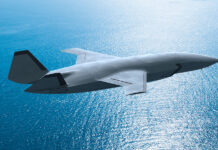
Australia has approved a third tranche of the locally designed MQ-28 Ghost Bat drone, awarding Boeing a AUS $754 million contract for seven more aircraft — including the first Block 3 variant with an internal weapons bay. This brings Australia’s total order to 18 Ghost Bats, supporting an operational capability by 2028, according to Mike Yeo of Breaking Defense. Officials highlighted a major milestone: the MQ-28 recently shot down an aerial target during a semi-autonomous test, teaming with an E-7 Wedgetail and F/A-18F Super Hornet and firing an AIM-120 missile. Boeing says the air-to-air capability was developed in just eight months, showcasing rapid progress and the drone’s growing role in future air combat. Yeo writes:
Canberra has green-lit a third tranche of the Australian-designed and -built MQ-28 Ghost Bat Collaborative Combat Aircraft from Boeing, an AUS $754 million (US$500.6 million) deal that will include several modifications to the design, including an internal weapons bay.
The new tranche will see Boeing deliver seven additional drones — six in the Block 2 configuration and the first Block 3 aircraft — over the next three years, to support the development of an operational capability by 2028 as well as supporting infrastructure under Australia’s AIR6015 Autonomous Collaborative Platforms – Air program. […]
Pat Conroy, the country’s Minister for Defence Industry, called the MQ-28 a world leading platform and the future of air warfare during a media conference announcing the contract.
“The future is here and the future is right now in Australia with Aussie made world-leading capabilities like the Ghost Bat,” he said.
Conroy also revealed during the contract announcement that the MQ-28 had engaged and shot down an aerial target at the Woomera range complex in southern Australia, an important milestone to show the drone’s capability.[…]
In a news release, Boeing said that all three aircraft involved launched from separate locations for the test, with an operator on board the E-7 took custodianship of the MQ-28 ensuring safety and engagement oversight, with the crew from the Super Hornet then teaming with the CCA in combat formation to provide sensor coverage. […]
The engagement saw the E-7 operating somewhere between 100 to 200 miles behind the MQ-28, and although the Super Hornet flew alongside the CCA during the event, it could operate at much further distances away during real world operations, said Ferguson.
Read more here.