

Writing for The Spectator, Alexander Kolyander explains that the budgets Russia’s finance ministry produces are “ignored by reality.” Kolyander writes:
The headline promise is a deficit of 2.2 percent of GDP next year, about 5.5 trillion roubles ($65 billion), down from roughly 3 percent expected this year. Revenues are to rise by 7.5 percent, which after inflation is barely 1 percent. Spending will grow by less than 6 percent, which after inflation is a cut of about 1 percent. For the first time since the invasion of Ukraine, the government even plans to start refilling the National Welfare Fund, the country’s rainy-day savings. Two-thirds of that fund has already been spent keeping Russia’s war economy afloat.
It all sounds admirably prudent – and it would be if anyone believed it.
Germany’s Chancellor Friedrich Merz explained his view recently that the Russian economy is in rough shape and can’t withstand the war indefinitely.
Germany’s Chancellor Merz:
The Russian economy cannot wage this war indefinitely. We know that the Russian economy has already reached its pain threshold: 7% inflation, a 14% central-bank rate, falling oil and gas revenues and an increasingly large state deficit. https://t.co/boj4l92eGz
— Clash Report (@clashreport) October 4, 2026
Despite Merz assessment, Russian President Vladimir Putin recently said that “The Russian economy is feeling confident.” Though feelings aren’t the basis for an economy.
Putin: Russia cannot — unlike some, let’s not point fingers — run around the world humiliatingly begging for handouts, nor does it need to
“The Russian economy is feeling confident. The main thing is not to make mistakes”, Putin noted. https://t.co/4aurqtCq8K
— Sputnik (@SputnikInt) September 30, 2026
It has been reported that on his recent visit to Russia, CIA Director John Ratcliffe warned the Russians that their economy could collapse. United24 Media’s Cyril Barabaltchouk reports:
Earlier reporting had already indicated that Ratcliffe brought Moscow a bleak assessment of Russia’s deteriorating military and economic position, after which the Russian leader Vladimir Putin reportedly canceled a planned meeting with him.
The latest FAZ account provides additional detail on the economic warning delivered during the visit.
According to FAZ, the US assessment distinguished between Russia’s military situation and its longer-term economic position. American intelligence reportedly viewed the battlefield as moving toward a stalemate, while concluding that Russia could not sustain the war economically.
“The economy will collapse, just as the Soviet Union did at the end of the Cold War,” the diplomat told FAZ, describing the assessment presented to Moscow.
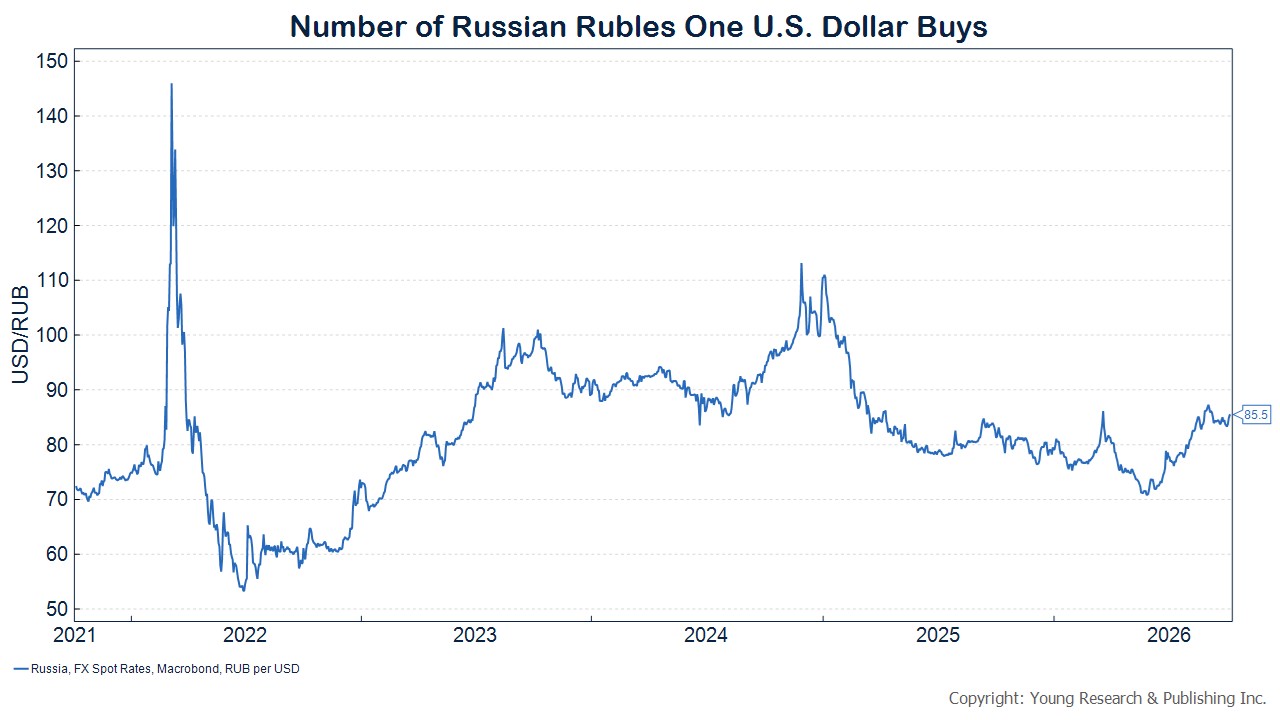
After a steep collapse in 2022 at the start of the war, Russia’s ruble quickly recovered by mid-2022. Afterward, the ruble became weaker, reaching a conversion of 113 rubles to a dollar in November of 2024. Subsequently, the ruble recovered to as low as 70.8 rubles to a dollar as recently as May 2026. Since then, though, the Russian economy has weakened, and the conversion rate has soared to 85.5 rubles per dollar today.
How long Russia’s economy can survive as its men are conscripted and its factories bombed is anyone’s guess. But it does seem hard to imagine that the war is beneficial for Russia’s economy in the long term.


