

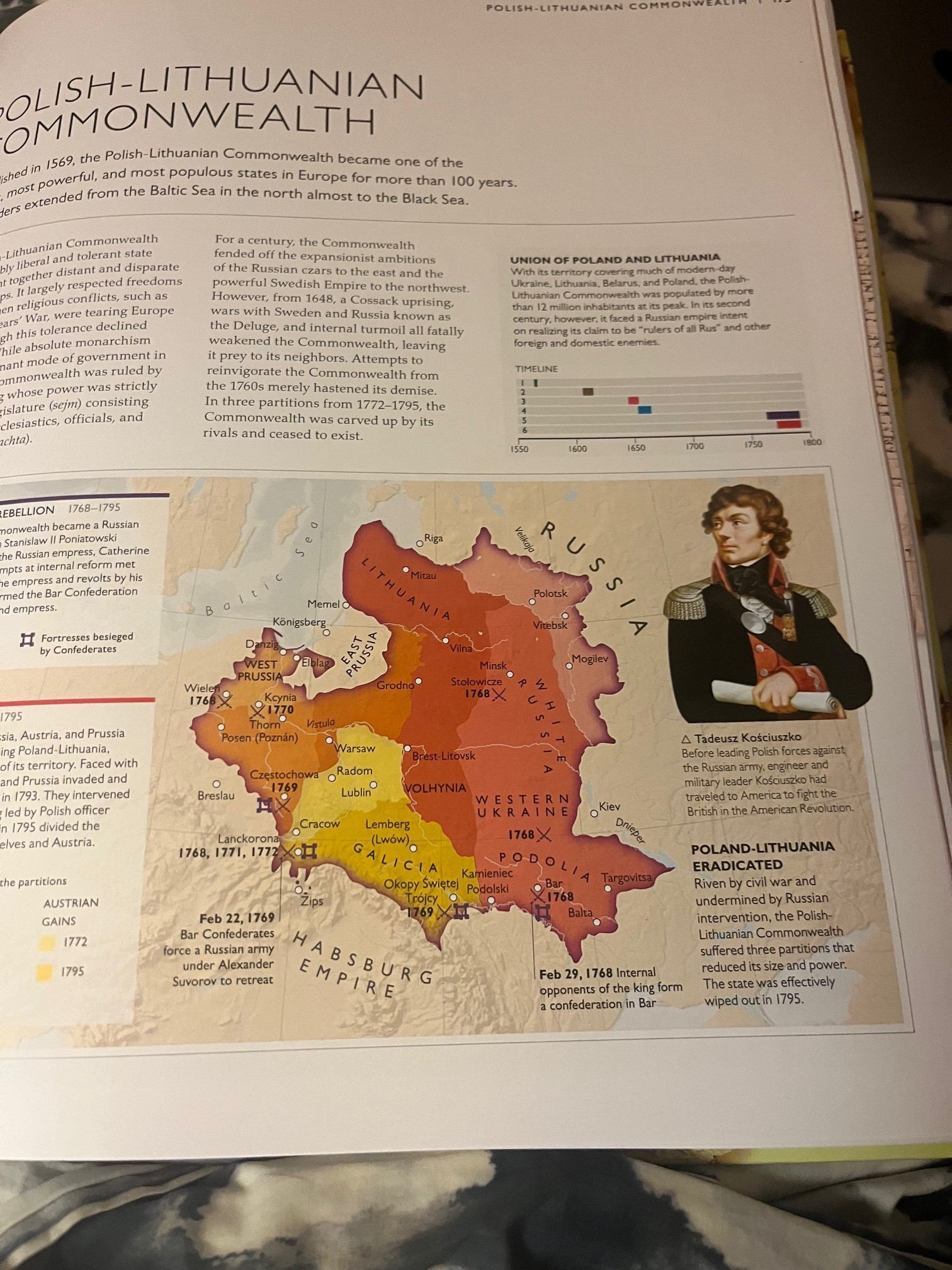
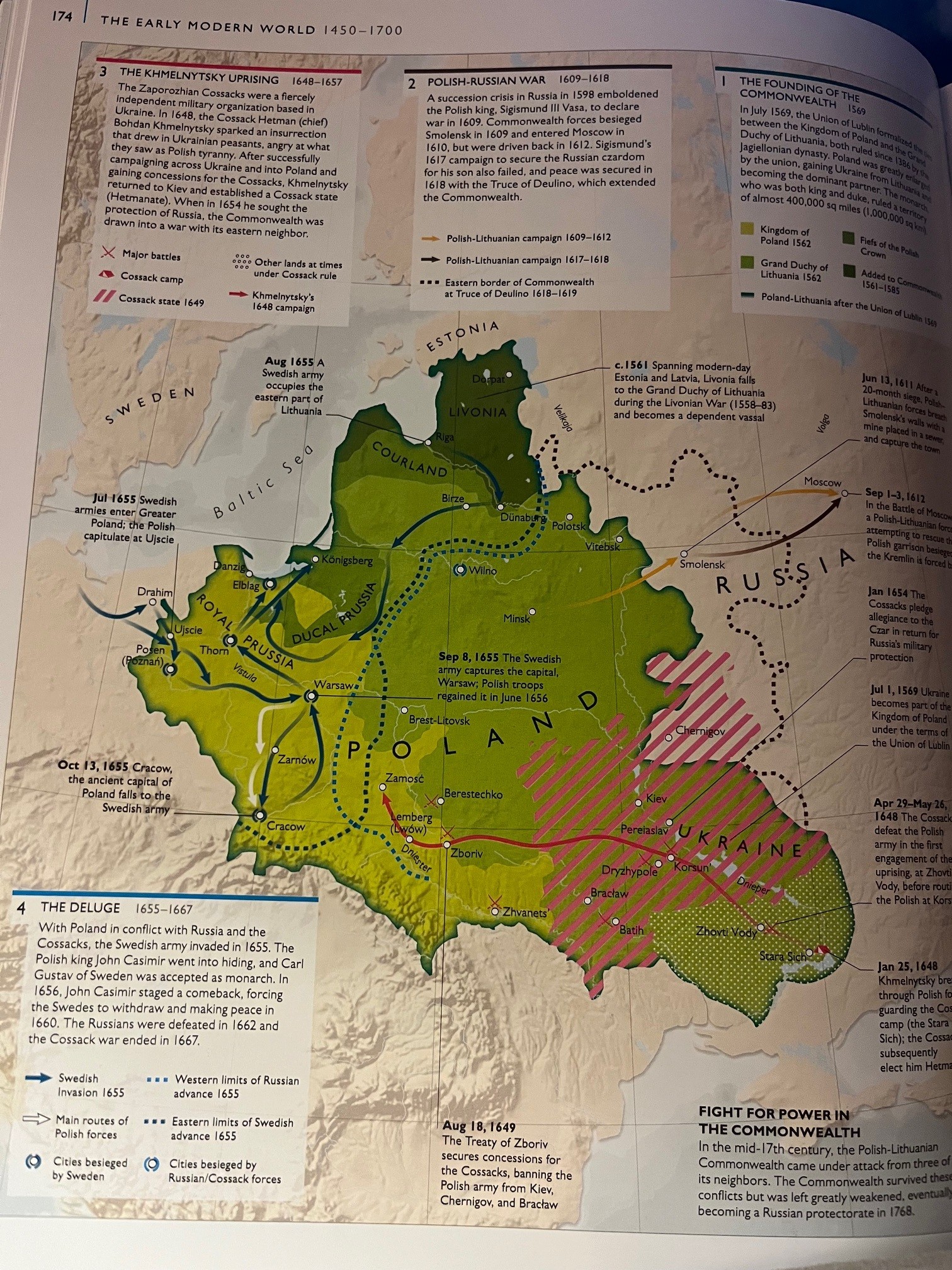
As Eastern Europe looks for ways to counteract Russia, an old idea is rising again. The commonwealth. Here’s a look at the Polish-Lithuanian Commonwealth that existed as a counterweight to Russia (and other threats) from 1569 to 1795. These images are from Smithsonian History of the World Map by Map by published by DK.
 Now, in the face of Russian aggression, Joe Z. Wells is calling for a similar “Polish-Ukrainian Commonwealth,” writing at Real Clear Defense:
Following a Ukraine-Russia ceasefire, Poland and Ukraine should hold a constitutional convention and form a united Commonwealth. This union would significantly enhance the economic and defense security of NATO. Since joining the European Union in 2004, Poland’s GDP has increased annually at 4%, significantly outpacing the economies of Germany, France, and Italy. By some estimates, Poland’s per capita GDP will exceed that of the United Kingdom by 2040. Poland’s extraordinary economic growth model could be replicated in Ukraine, creating a manufacturing, agricultural, and mining juggernaut. The Commonwealth could court trade and investment from the United States by diversifying critical supply chains away from the People’s Republic of China (PRC). In time, the Commonwealth could build the capability and capacity to extract and refine rare earth metals at scale. Additionally, the Commonwealth could responsibly produce essential precursors to pharmaceuticals. This would not only create a reliable source outside of the PRC but also constrain their use in the illicit drug trade. By weakening the PRC stranglehold on rare earths and pharmaceutical precursors, the Commonwealth would be a critical partner to the U.S. and its allies for years to come.
NATO inclusion would not be automatic but would most likely follow the model of German unification. The newly formed Commonwealth would negotiate terms of NATO membership just as a unified Germany did at the Paris Agreements in 1990. Because ongoing territorial disputes would be a sticking point to NATO accession, the Commonwealth would likely have to yield conquered land to Russia. This would be a bitter pill to swallow but could be softened by constraining and taxing Russian exports. All likeminded nations that currently support Ukraine could agree to restrict the importation of Russian goods by requiring their transport over Ukrainian territory. Future Russian exports would not be permitted to be delivered by NORDSTREAM pipelines or ships but instead would have to travel via pipeline, rail, or truck through the Commonwealth. This requirement would enable the Commonwealth to extract reparations by taxing the transport of all Russian exports. This agreement could be ratified by treaty and extend over a certain period of time or up to a specified amount of revenue. This would set a useful precedent that would influence PRC calculus to invade Taiwan. Despite battlefield results, aggressors will suffer long-term economic consequences.
Not only an economic powerhouse, the Commonwealth could serve as an arsenal for democracy. Since Russia’s 2022 invasion, NATO nations have been embarrassingly slow to increase the production of munitions or unmanned systems in a meaningful way. The Commonwealth could scale the production of explosives, fuses, and artillery rounds to replenish NATO and ally stocks. Moreover, the Commonwealth could leverage its warfighting experience to train and arm NATO nations with battle-tested unmanned systems to sense, strike, protect, and sustain. No military has integrated and employed unmanned systems more than Armed Forces of Ukraine. The Commonwealth could partner with allies to address electronic warfare capability shortfalls among allies. Ukraine has demonstrated that electronic warfare is critical on the modern battlefield. When leveraged correctly, it can increase one’s survivability or enable kinetic targeting of the enemy. Finally, the Commonwealth could model or join recent U.S.-UK nuclear initiatives aimed at driving down the cost of energy for consumers and producers alike. Upstream, the Commonwealth could speed the approvals and construction of advanced nuclear reactors (ANRs) and integration into the power grid. Downstream, the Commonwealth could fabricate specialized components for these reactors or host facilities that process, recycle, and safely dispose of nuclear material.
Read more here.


