
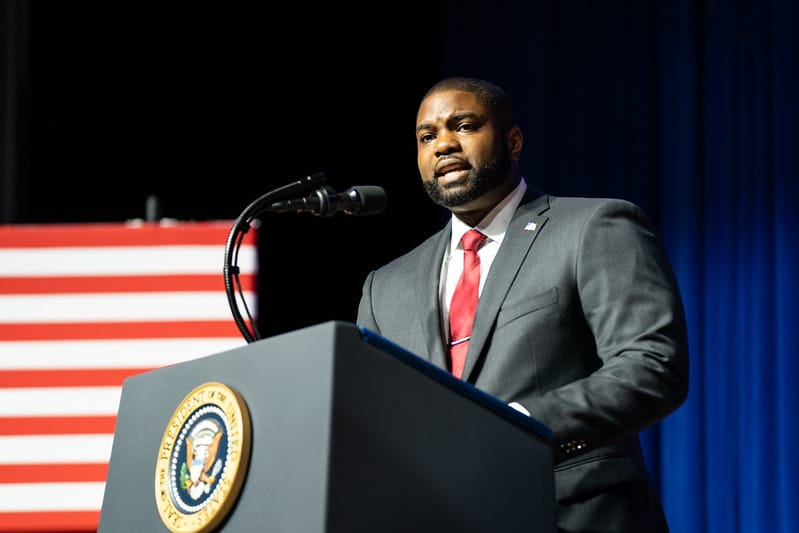
This January, reports The Wall Street Journal, the U.S. will have four new black governors: Keisha Lance Bottoms of Georgia, Aaron Ford of Nevada, Byron Donalds of Florida, and David Crowley of Wisconsin.
All will join Maryland’s Wes Moore, who was re-elected this month to a second term.
Understandably, writes Jason L. Riley in the WSJ, Black people view these political developments as a “point of pride.”
Their wins exemplify significant racial progress in a country that legally forbade Blacks from voting or holding elected office.
- Bottoms is the first black woman elected governor in U.S. history.
- Donalds will be the first elected black Republican governor.
- Ford will be the first black governor of a state located west of the Mississippi River.
For long among whites, education and gender have been strong signals on how one will vote. Coincidentally, “recent elections suggest that non-white voters have begun to display some of the same tendencies,” writes Mr. Riley:
In 2020 significant percentages of black and Latino men fled the Democratic Party and started voting more like working-class whites. Exit polls this year showed that black voters were even more likely than other groups to cite the economy as their top issue. If racial identity has become less of a factor in how white and non-white voters choose candidates, we’re moving in the right direction.
The US has already elected a black president and a black VP. Since the 1970s, it’s not uncommon for blacks to be mayors of major cities. Today, notes Mr. Riley, two of the country’s three largest metropolises, Los Angeles and Chicago, have black mayors.
And before Zohran Mamdani replaced Eric Adams this year as mayor of New York, blacks had a trifecta.
Nonetheless, continues Mr. Riley, “it would be difficult to argue that black political power has been a boon for the black poor.”
Politically connected blacks did fine in Coleman Young’s Detroit in the 1970s, Marion Barry’s Washington in the 1980s and Sharpe James’s Newark, N.J., in the 1990s, but the black poor fell further behind. Following the Great Recession, the unemployment rate didn’t fall below double digits for blacks until Barack Obama’s seventh year in office, while it never reached double digits for whites. Political scientists Gary Orfield and Carole Ashkinaze’s assessment of black political gains in the 1970s and ’80s concluded that they “do not necessarily produce success for blacks as a whole.” Rather, the evidence “indicates that there may be little relationship between the success of local black leaders and the opportunities of typical black families.”
Economic growth, equal opportunity and human capital development have helped lagging groups far more than expanding the welfare state, implementing racial preferences or electing public officials who happen to share their ethnic background.
For decades, Asian Americans have led all groups academically and economically in the U.S., yet they have nowhere near the political power of whites or blacks.
According to Richard Vedder:
“The greatest twenty-five years of black progress after Emancipation itself came between the early postwar period and around 1973. The real median income of the black population more than doubled between 1948 and 1973, increasing an astounding 3 percent a year… If averages instead of medians are used to calculate real income, the increase was even larger.”
Liberals’ focus is on what government should do to help poor people. Mr. Riley has a better idea: allow economic growth and opportunity to help poor people become independent from the political class.
Despite Jim Crow, tight labor markets in the 1940s and ’50s helped reduce the black poverty rate from 87% to 47%. A strong economy in the 1960s doubled the incomes of black households. Economic growth during the Reagan era also disproportionately helped black workers. A New York Times front-page headline from 1992 reads: “White-Black Disparity in Income Narrowed in the 80’s, Census Shows.”
Jason Riley also notes how political solutions to what are mainly cultural problems are often misguided.
“It is important and right that all privileges of the law be ours,” said Booker T. Washington, “but it is vastly more important that we be prepared for the exercises of these privileges.”
It’s the difference between having opportunities and seizing them.


